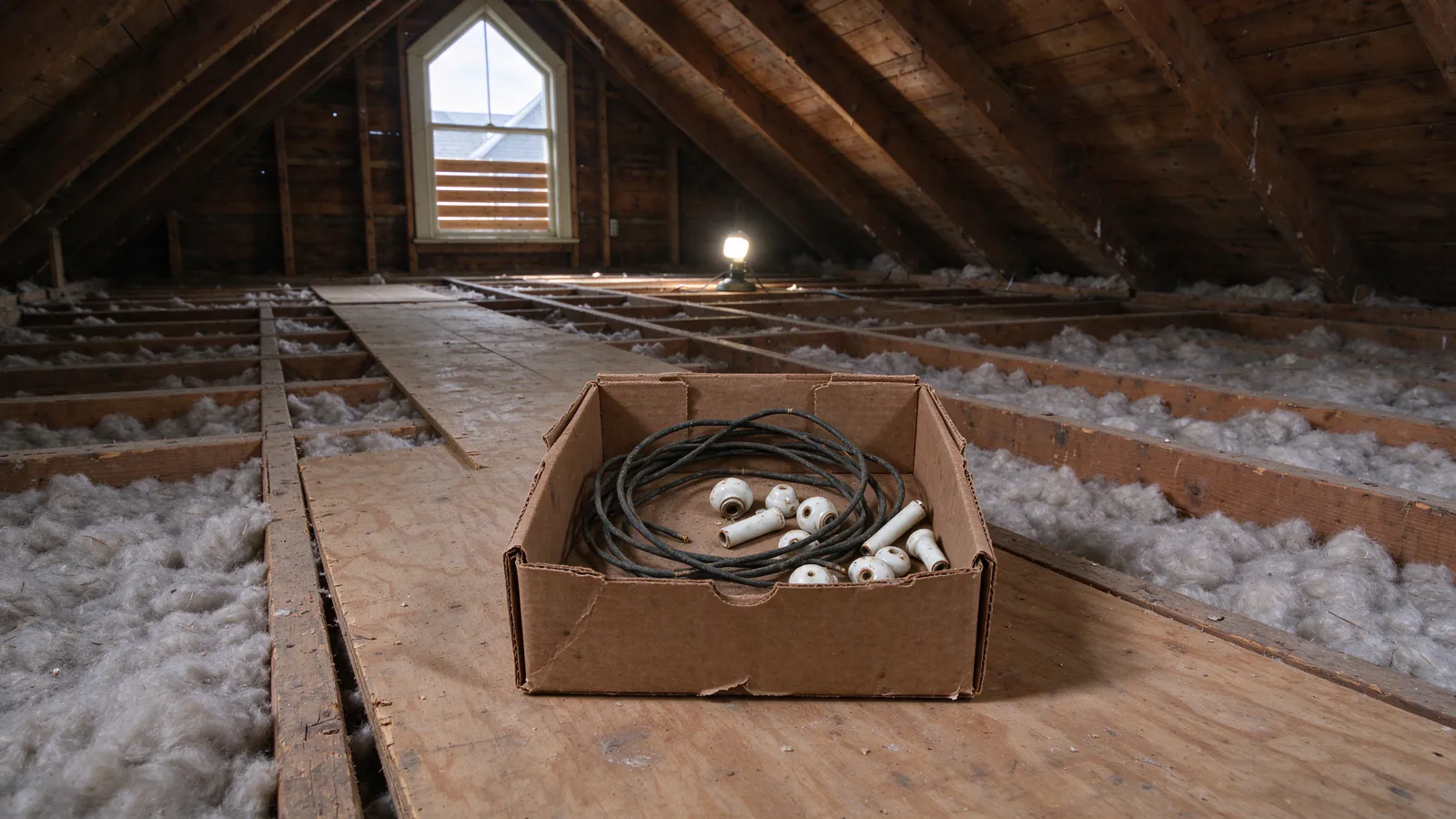
Is the old wiring in your house live, dead or both?
You’ve seen knob and tube in the basement or attic, and now your insurer or a buyer wants to know if it’s active. Telling live from dead takes testing, not a look.
Every K&T run is in one of three states, and the state decides both the risk and what your insurer hears. At Conflux Cincinnati Knob and Tube we trace, disconnect and replace K&T in Cincinnati, Hamilton County and Northern Kentucky, and every job starts with us sorting each run into one of these states.
| State | What it means | What it needs |
|---|---|---|
| Active | Connected at the source and able to carry current, whether or not anything is switched on | Replacement, or a written decision to keep it for now |
| Abandoned | Disconnected at the source and at its far end, tested and recorded | Nothing more, beyond keeping the record |
| Mixed | A circuit that is part K&T and part newer cable, or a house with both live and dead runs | Tracing every branch before anyone calls it dead |
Why can’t you tell by looking?
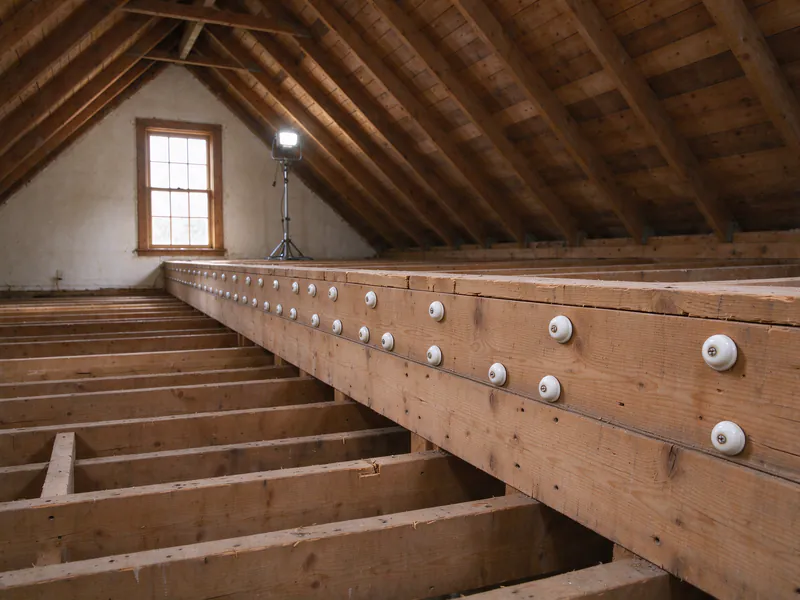
Because dead and live K&T look the same. Both are grey with dust, both sit on the same porcelain, and both may lead to an old fixture box. Age and condition tell you nothing about whether current can flow.
These are the traps:
- A run that ends in mid-air in the basement. Someone may have cut it at that end and left the other end connected.
- A modern outlet. Original K&T inside the wall can feed it, with new cable only for the last few feet.
- A light that doesn’t work. The bulb may be dead, the switch off or the fixture gone, and the wiring can still be live.
Isn’t a voltage pen good enough?
No. A non-contact voltage tester lights up when it senses voltage near a wire. It can miss a live wire that’s switched off, shielded or simply not under load at that moment.
So when a pen lights, it tells you “live”. When it doesn’t, it can’t tell you “dead”. On a knob and tube inspection we trace circuits and test at both ends instead.
How do we prove a run is dead?
In a set order, because skipping a step is how mistakes happen. On the first visit we follow the same sequence for every K&T run we find.
- Trace to the source. We match each fuse or breaker to what it feeds and check its size against the wire.
- Follow the run. We follow the attic and basement runs we can reach and note splices and where the wire enters walls.
- Test with switches in every position. We check lighting circuits with switches on and off, so we don’t miss a switched leg.
- Confirm both ends. A run counts as dead only when it tests dead and we’ve disconnected it at the panel end and at its last device or splice.
- Write it down. Your circuit list marks each run replace now, replace later or dead.
Why isn’t cutting one end enough?
A run cut at the panel but still joined to a live circuit at a hidden splice can be fed from the other end. A run cut at the far end but left on its fuse is still energized up to the cut. Both look disconnected, and neither is.
Why are most houses a mix?
Because decades of owners changed things. They replaced some circuits, added others, and spliced new cable onto old runs to reach a new outlet or light.
That leaves circuits that are part K&T and part newer cable. They don’t look like K&T at the outlet or the panel, only in the attic or a ceiling. Our guide to K&T spliced into Romex explains why those joints matter.
What do we do with the dead runs?
Once we’ve disconnected and recorded abandoned K&T, it can stay where it is. We can take out the runs in an open basement or attic. Runs inside finished walls usually stay, because pulling them would mean opening plaster for no electrical gain.
Knob and tube removal shows how we disconnect and record old runs. Where a run is live and you still need it, partial replacement swaps it for new grounded cable.
What will your insurer want to see?
Proof. “Abandoned” only helps you if someone else can check it. Our disconnection record lists each retired run, where we cut it at both ends, how we tested it, and photos of the ends.
Put that record with the circuit map and the IBI permit final, and it answers the question carriers ask most: is any K&T still active? Our guides to paperwork for insurers and K&T insurance in Ohio explain how underwriters read it.
How do you find out which state yours is in?
If you’ve seen K&T and don’t know whether it’s live, it’s worth a visit before an insurer or buyer asks. Our guide to identifying K&T covers what you can safely check yourself first.
Call (513) 496-2715 to book the tracing visit, or send what you’ve seen through the form below.