Think you’ve spotted it in your basement?
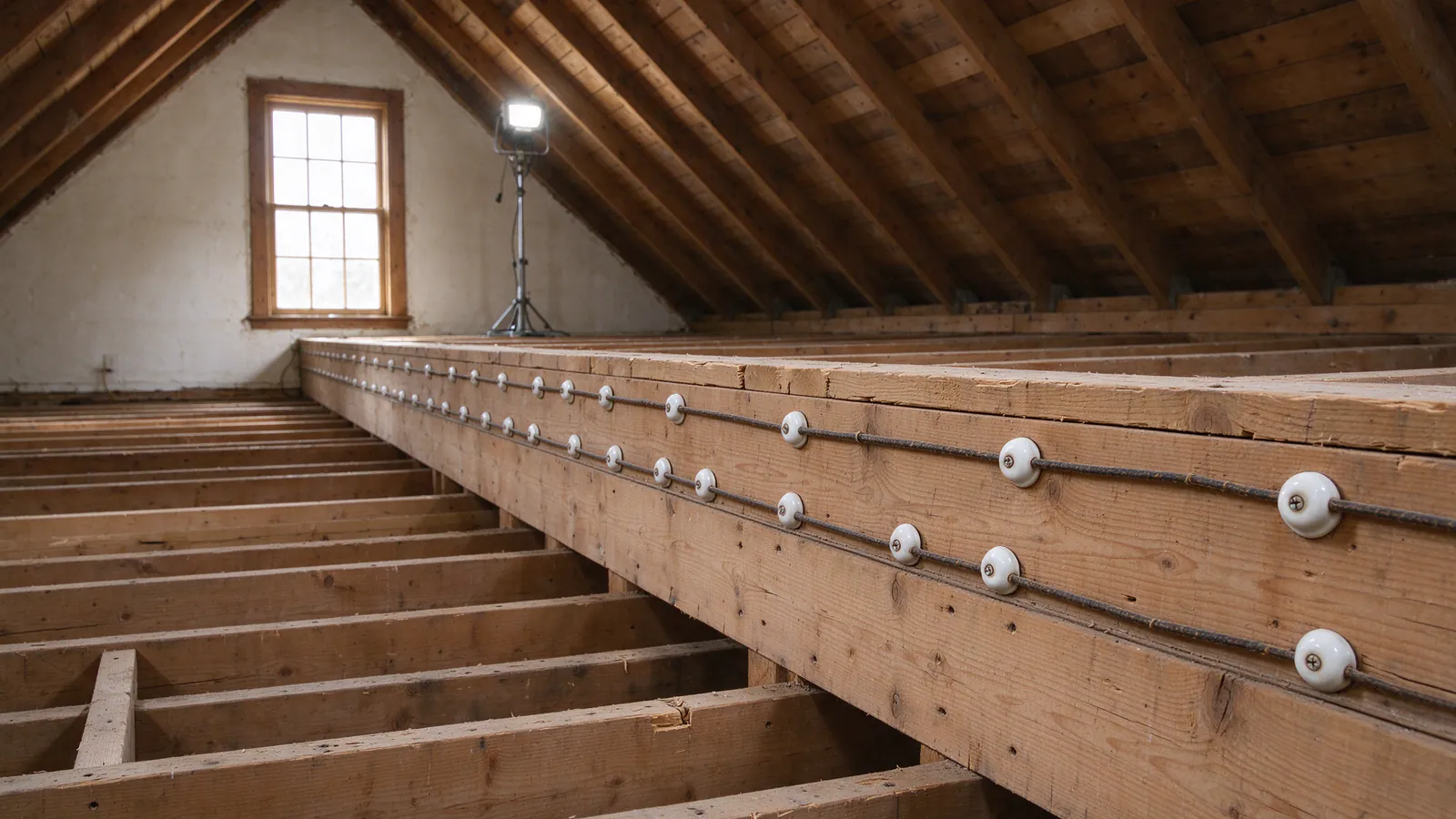
Here’s how to identify knob and tube wiring: look for two separate wires, a few inches apart, running along or through the framing on white porcelain. Modern cable keeps its wires together in one sheath; K&T never does.
At Conflux Cincinnati Knob and Tube we do knob and tube inspection and replacement across Cincinnati, Hamilton County and Northern Kentucky. This guide covers what you can safely see for yourself before we visit.
What do the knobs and tubes look like?
The porcelain gives the system its name, and it usually outlasts the wire it holds. Each piece has one job.
- Knobs. Small white or cream porcelain spools nailed to joists or studs. The wire wraps around or rests on them, held off the wood.
- Tubes. Porcelain sleeves set into holes bored through joists or studs, so the wire passes through the wood without touching it.
- Loom. A woven, flexible sleeve over the wire where it enters a box or fixture, often dark and frayed with age.
- Splices. Wires twisted together, soldered and taped out in the open, between knobs rather than inside a box.
Where should you look, and from where?
Wherever the framing is open, from a spot where you can stand safely. Stop at the edge of what you can see without moving anything.
| Place | What to look for | How to look safely |
|---|---|---|
| Unfinished basement | Pairs of wires on knobs along the joists, heading up into walls | From the floor, with a flashlight; don’t reach above the panel |
| Attic | Wires on knobs across the joists, or disappearing under insulation | From the hatch only; don’t walk the joists or move insulation |
| Crawlspace | The same pairs along the floor framing | From the access opening |
| Fuse or breaker panel | Single wires entering separately, cloth-covered | Look at the outside; leave the cover on |
If insulation covers your attic floor, you may see nothing even when K&T runs underneath. That’s a reason to have it traced, not a reason to dig.
Which clues point to it without proving it?
A few things in your finished rooms suggest K&T. Each also has other explanations, so treat them as reasons to check, not as answers.
- Two-prong outlets. Common on K&T, but also on early cable without a ground.
- Push-button switches. Original to many pre-war houses, though some have been rewired since.
- A screw-in fuse panel. Common with K&T, but someone may have replaced the branch wiring.
- Ceiling lights with a pull chain, or one wall switch per room. Typical of early layouts.
- Cloth-covered wire at a fixture. Could be K&T or later cloth-insulated cable.
Is it knob and tube, or later cloth cable?
People often mistake cloth-covered cable from the following decades for K&T, and your insurer cares about the difference. The test is the layout, not the cloth.
| Feature | Knob and tube | Early cloth-sheathed cable |
|---|---|---|
| Wires | Two single wires, run apart | Two (sometimes three) wires inside one sheath |
| Supports | Porcelain knobs and tubes | Stapled or strapped to framing |
| Splices | Soldered and taped in open air | Inside metal boxes |
| Ground | None | Sometimes a bare ground, often none |
What can’t you tell just by looking?
Looking finds K&T where the framing is open. It can’t tell you whether that K&T is live, where the hidden runs go, or whether a modern-looking outlet is fed by original wire inside the wall.
Homeowners often ask how to confirm what an electrician saw behind one outlet. The answer is tracing: we match each fuse or breaker to what it feeds and test each run at both ends. Our guide to active versus abandoned K&T explains how that works, and the assessment quiz helps you sort out what you’ve seen.
What’s worth writing down?
A few notes now save time on the first visit and help with an insurer or buyer later. Keep them simple:
- Where you saw K&T: basement, attic, crawlspace, and roughly under which rooms
- Whether it disappears under insulation or into walls
- The panel type, fuse or breaker, and any fuses that look bigger than their neighbors
- Rooms with only two-prong outlets, or lights that flicker on one circuit
We fold those notes straight into your circuit list. The fuse box replacement page explains why fuse sizes matter, and attic insulation covers runs hidden under insulation.
When should what you see make you call right away?
If you see damaged insulation, bare copper, scorch marks or wires resting on wood, or you smell burning, treat it as urgent. Our guide to warning signs sorts urgent findings from ones that can wait.
Otherwise, note what you saw and where, take a photo from a distance, and call (513) 496-2715. Our primer on knob and tube explains the rest of the system.