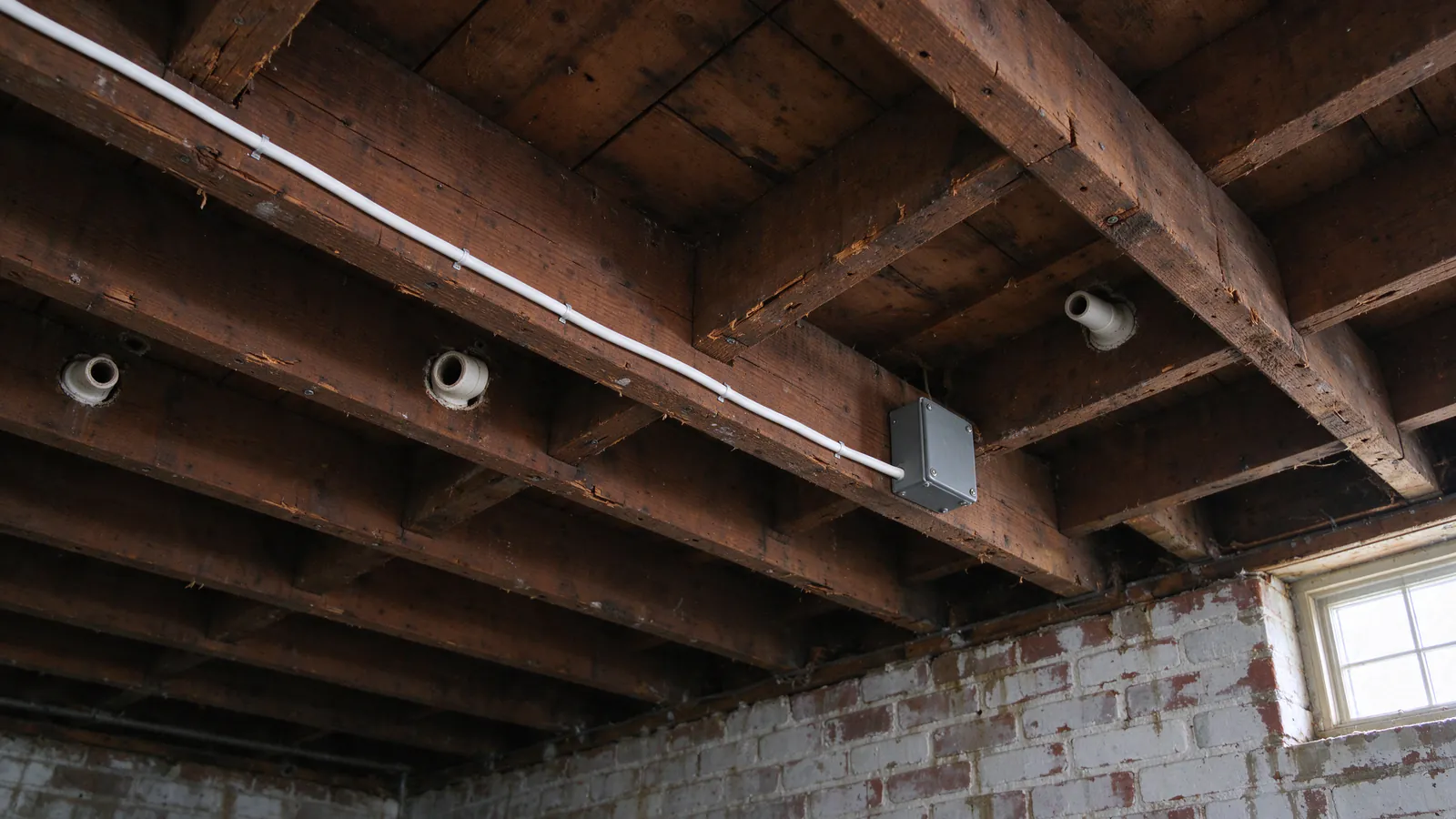
Found new cable joined to old wire in your attic?
Then you’re asking the right question. “Can knob and tube be connected to Romex?” sounds like a wiring question, but it’s really two others: will the inspector accept that joint, and what does it mean for your insurance? A diagram answers neither.
At Conflux Cincinnati Knob and Tube we trace circuits and replace K&T across Cincinnati, Hamilton County and Northern Kentucky. This guide explains the issues, so you can judge what you find and what you’re told.
How did your house end up with a mix?
Through decades of small jobs. Someone added an outlet, moved a light or remodeled a kitchen, and the shortest path was to run new cable to the nearest old wire and join it there.
That leaves a circuit that’s new at both ends you can see and original in the middle. It’s the main reason an outlet test and a panel check can both say “modern” while the active K&T question stays open.
Where do bad splices fail?
At the joint, because every joint is a place for resistance and heat. The original K&T splices were soldered and taped in open air. Later joints often weren’t.
| What’s wrong at the joint | Why it causes trouble |
|---|---|
| Twisted and taped, no solder or connector | Loosens as it heats and cools; a loose joint arcs |
| Buried in a wall or ceiling, no box | Heat and sparks have nowhere safe to go, and nobody can inspect it |
| Brittle K&T insulation at the joint | Cracks when someone disturbs the joint, exposing copper |
| Under attic insulation | Traps the heat a loose joint makes |
| One circuit’s neutral joined to another | Shared neutrals that overload a wire and confuse protective devices |
It’s a short step from a bad splice to a fire hazard: a loose joint heats up, the heat hardens the insulation nearby, and the joint starts to arc. An arc can ignite dust or wood without drawing enough current to blow a fuse.
What does the code expect at a joint?
A box. Electricians splice modern cable inside boxes, which contain heat and sparks, protect the joint and keep it where someone can inspect and repair it.
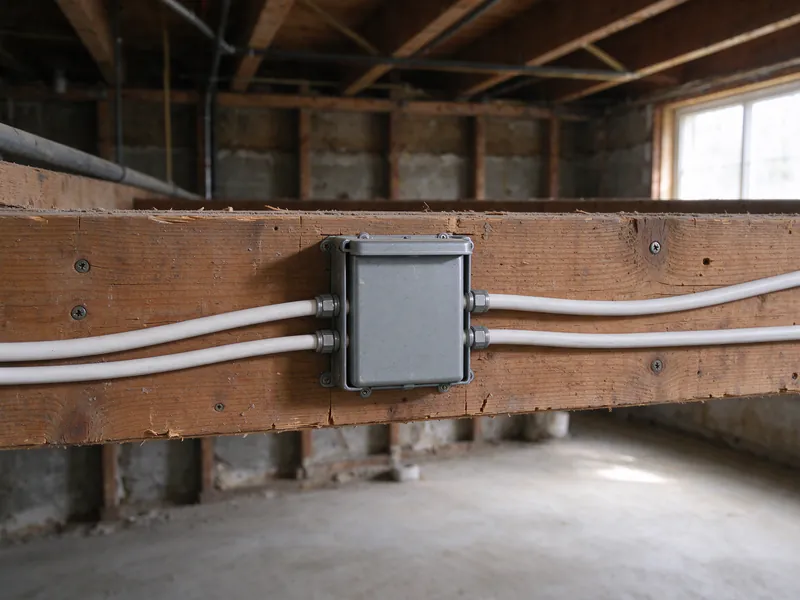
Two rules matter most for mixed circuits:
- A box at every cable splice. A taped joint floating in a wall cavity isn’t an acceptable splice for cable.
- Boxes stay accessible. A box buried under plaster or drywall is a hidden box, and hidden boxes are among the first things an inspector or electrician looks for.
What do we check at each joint?
When we trace a mixed circuit, we follow each run from the panel and note every place the wire type changes, without disturbing brittle insulation any more than testing needs.
- Whether the joint is in a box, and whether the box is accessible
- Whether the K&T insulation near the joint is intact or cracked
- Whether the joint shows heat: discoloration, melted tape, a scorched box
- Whether two circuits share a neutral
- Whether three-prong outlets downstream have a real ground
All of it goes on your circuit list. Our knob and tube inspection page explains the full first visit.
Why don’t your three-prong outlets have a ground?
Because new cable carries a bare ground wire and K&T has nothing for it to join. A three-prong outlet fed through a splice to K&T looks grounded and isn’t.
Some splices “solve” this by tying the ground to the neutral. That bootleg ground makes a plug-in tester read correctly while putting current on metal parts under some faults. It’s unsafe and not allowed. Our grounding service explains the legitimate options.
What does a splice mean for your insurance?
It means your K&T is still active. Insurers usually ask whether any K&T is live, and a circuit with K&T in the middle is, however new its ends look. Extending a K&T circuit also puts more load on the old wire.
That’s why spliced circuits are a common gap between what an owner believes and what the insurer’s question covers. Our guide to K&T insurance in Ohio covers how carriers approach it.
How do we replace a spliced circuit?
We run new grounded cable from the panel to the last device on the circuit, so the K&T section is bypassed, then disconnect the old section at both ends and record it.
When several circuits are spliced, the job becomes partial replacement or a whole-house rewire. A short, local repair can make sense in a few cases; repair or replacement explains when.
Think some of your circuits are spliced?
Homeowners often ask how to find which original circuits someone spliced into. The answer is tracing from the panel, not opening walls at random. Note any rooms where the outlets are new but the ceiling lights are original, and any warm or buzzing fixtures.
Then call (513) 496-2715 and we’ll trace the circuits. Our guide to warning signs lists the symptoms worth mentioning.