Why can’t anyone just give you a number?
You want to know how long it takes to rewire an old house so you can plan your life around it. The honest answer is a sequence: each stage has its own pace, and your house decides how long the middle stages run.
At Conflux Cincinnati Knob and Tube we handle whole-house rewiring and partial K&T replacement across Cincinnati, Hamilton County and Northern Kentucky. We put your schedule in the written scope after the first visit, not before.
What are the stages, and which ones run long?
Every permitted rewire goes through the same steps. Some are short and predictable; others depend heavily on the house.
| Stage | What happens | What makes it longer |
|---|---|---|
| Assessment | We trace, test and list every K&T circuit | Many circuits, buried attic runs, a mixed system |
| Scope and permit | You get a written scope; we open the IBI permit | Plan review for larger buildings; decisions you’re still making |
| Rough-in | We fish new cable, set boxes and cut old circuits over | More live circuits, closed attics, plaster on brick, several stories |
| Rough-in inspection | IBI inspects before we cover anything | Scheduling, or a failed inspection and a reinspection |
| Devices and panel | We fit outlets, switches and fixtures, and size and label breakers | A panel change, a service upgrade, utility coordination |
| Final inspection | IBI checks the finished work | Scheduling, corrections |
| Patching and painting | We close and finish the openings | Many openings, lath or brick plaster, historic finishes |
What makes the rough-in take longer in your house?
Rough-in is where most of the electrical hours go, and your house decides how many. The same floor area can mean very different work.
- Live circuits. Each circuit we replace is a route to plan and fish. Dead runs only need disconnecting.
- Access above and below. An open attic and an unfinished basement let us drop cable straight into the walls.
- Plaster. Lath and plaster, or plaster on brick, needs more careful openings; see plaster-wall rewiring.
- Stories and framing. Balloon framing can let cable run floor to floor; platform framing stops it at each floor.
- Insulation. If K&T is buried in attic insulation, we have to find it before we can trace it.
Why is there a wait before the walls close?
Because IBI has to see the rough-in before any of it is covered; it says it can’t approve what it can’t inspect. So there’s always a pause between running cable and closing walls.
The permit itself is quick: the City’s guide says an IBI electrical permit takes about 15 minutes at the counter. How soon the inspector visits depends on IBI’s schedule at the time. A failed rough-in adds a return trip and pushes patching back further; our Cincinnati electrical permit guide covers the steps.
Why does patching come last, and why can’t it be rushed?
Patching can’t start until IBI passes the rough-in. Plaster openings close in coats, and each coat has to set before the next. Painting follows.

Who patches changes the schedule too. If restoration is part of the electrical scope, it follows the final inspection. If you hire a plasterer yourself, their calendar sets the pace. Either way, get it in writing.
Can you live in the house during a rewire?
Yes, in most cases. Most rewires happen with people at home, because we turn power off circuit by circuit rather than for the whole house, and you get finished rooms back as the work moves on.
Living at home comes with a few ground rules, which we set out in the scope:
- One working circuit stays live for a freezer, a home office or a medical device.
- Your heat stays on in winter. The Cincinnati airport averages 31.4°F in January (NOAA normals), so we switch the furnace or boiler circuit over within the day.
- Multi-unit buildings. We sequence the work so people in the other units keep power.
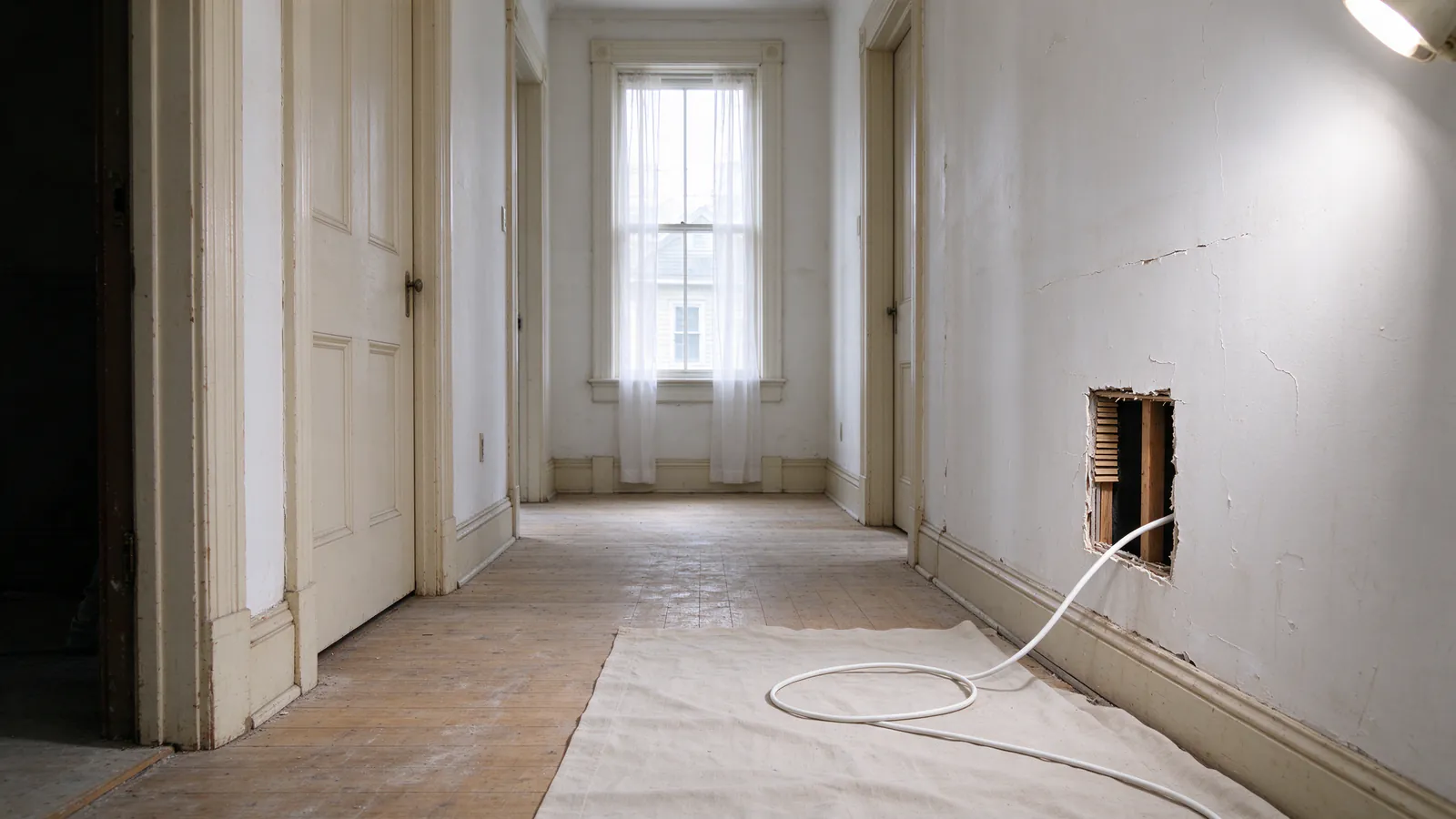
- Protected rooms. We lay floor coverings and control dust wherever we cut openings.
The whole house loses power only for a panel switchover, which we schedule ahead. Preparing for a rewire covers what to move and plan before work starts, and two-family and rental rewiring covers occupied units.
When does it make sense to stay somewhere else?
Some households choose to be away for part of the job. It’s a preference more than a requirement, and it usually comes down to one of these:
- Someone at home is sensitive to dust or noise
- Most rooms need openings at the same time, as in a fast whole-house job
- Remodeling or plaster work is happening alongside the rewire
How do you get a schedule you can plan around?
Ask for the schedule in the same document as the scope. A useful one lists the working days for rough-in, when each inspection should happen, the switchover date if the panel changes, and who patches and when.
Our guide to comparing rewiring quotes shows how to check that two quotes schedule the same job, and how replacement works follows a job step by step. To start with the assessment, call (513) 496-2715.