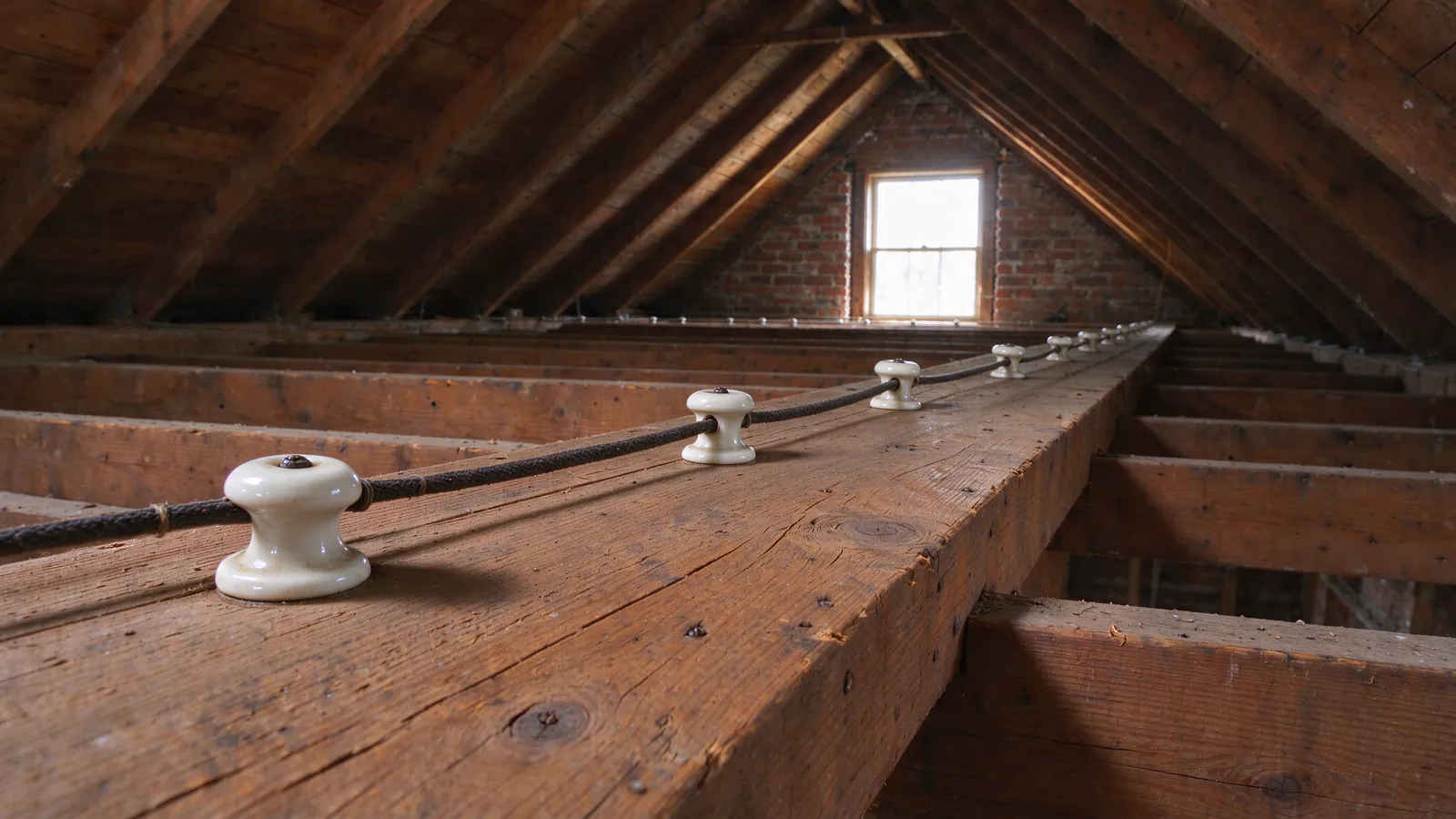
What will actually happen in your house?
How is knob and tube replaced? We do it one circuit at a time, working from a map, while you keep living there. The order below is the same whether we’re replacing one circuit or the whole house; only the number of repeats changes.
This is how we run a job at Conflux Cincinnati Knob and Tube, across Cincinnati, Hamilton County and Northern Kentucky, always under an electrical permit.
- Inspection and circuit mapping
- The rewiring plan
- Permit
- Protection and routes
- Rough-in: new cable and boxes
- Rough-in inspection
- Devices, panel and testing
- Disconnecting the old runs
- Final inspection, patching and records
What do we do on the first visit?
We turn your old wiring into a list. We trace every K&T circuit to its fuse or breaker and check each fuse size against the wire.
We follow the attic and basement runs and confirm each one live or dead at both ends. You get a written circuit map:
- What each circuit feeds, room by room
- How many openings each room will need
- A status for every circuit: replace now, replace later or dead
We don’t price or plan anything until that list exists.
How do we turn the map into a plan?
The map shows what you have; the plan decides what replaces it. This is where we lay the house out for how you use the rooms now, not how someone wired them a century ago.
| Decision | What the map shows | What the plan sets |
|---|---|---|
| Circuit count | A few long circuits serving several rooms each | More, shorter circuits; dedicated circuits for kitchen, bath and heavy appliances |
| Routes | Where old runs go and where access exists | Which walls we reach from the attic, which from the basement, which need an opening |
| Panel | Fuse sizes, panel space, service rating | Whether the panel or service changes, and when |
| Order | Which circuits matter most | Sequence, so one working circuit and your heat stay on |
| Scope boundary | Live, dead and mixed runs | What we replace now and what we record for later |
If we’re replacing only some circuits, the plan is a partial replacement with a written boundary. If K&T runs through most rooms, it’s a whole-house rewire.
What kind of wire goes in?
Most house rewires use NM-B cable, sold under trade names such as Romex: two insulated wires and a bare ground inside one plastic sheath. That ground is the main thing K&T never had.
NM-B isn’t right everywhere. Some spots call for armored or metal-clad cable, for example where the cable could get damaged, and buildings of four or more units follow the Ohio Building Code, which can change the wiring method. Our plan names the cable for each run, and IBI inspects it.
How does new cable get into plaster walls?
Mostly from above or below. From an open attic, we drop cable into a stud bay; from an unfinished basement, we bring it up. Closets, chases and stacked walls carry runs between floors.
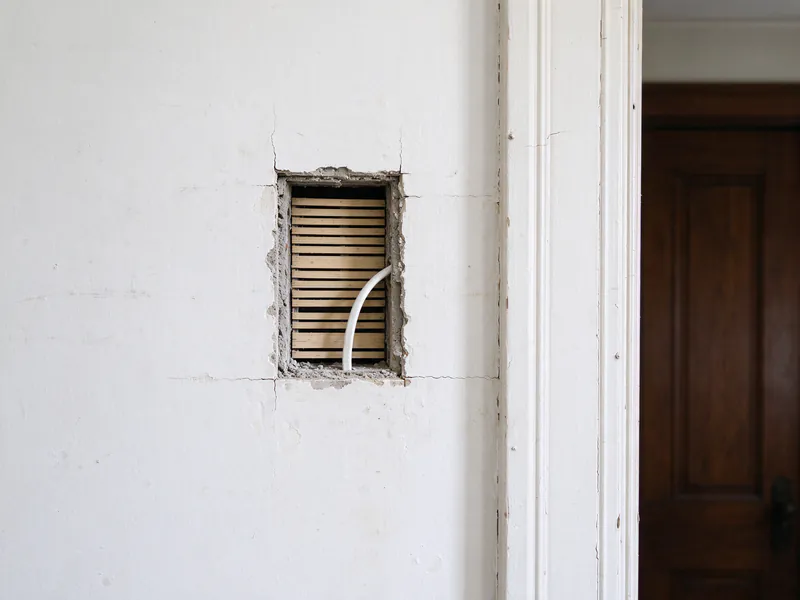
Where there’s no hidden path, we cut small openings at fire blocks, behind baseboards or at device locations, and list each one for patching. Plaster-wall rewiring explains how we keep openings few and patchable.
What happens at rough-in, and when does IBI come?
Rough-in is when we run the new cable and set the boxes, before anything closes up. We shut off one circuit at a time, run new cable from the panel to every point on that circuit, and set or replace the boxes.
Then IBI inspects the rough-in. It won’t approve work it can’t see, so every opening stays open until the inspector passes it. Our Cincinnati electrical permit guide lists what the inspector checks.
When do the new outlets and switches go in?
Once the rough-in passes. Every outlet on a replaced circuit becomes a grounded three-prong receptacle, we connect switches to the new wires, and we reconnect or replace fixtures.
- Receptacles. Grounded through the new cable’s ground, with GFCI where the code requires it, such as kitchens and baths.
- Switches. Wired to the new circuit. We keep period push-button switches only where a compatible mechanism goes in.
- The panel. Each new circuit lands on a breaker sized to its wire, with AFCI or GFCI breakers where required, and gets its own line in a labeled directory.
Then we test each circuit: continuity, polarity, a working ground at every receptacle, and protective devices tripping as they should. Our guide to AFCI and GFCI explains those devices.
What happens to the old wiring?
We retire each old run once its replacement is live. We disconnect it at the panel end and at its last device or splice, test it dead, tag it and photograph it.
We can take out runs in open attics and basements; runs inside walls stay, disconnected. Knob and tube removal shows how we make that record, and active versus abandoned K&T explains why both ends matter.
What do you get at the end?
IBI comes back for the final inspection. Once it passes, we patch the openings to the finish we agreed, and hand the job over with its records.
| Record | What it shows |
|---|---|
| Circuit map | Every circuit, the rooms it feeds and its status |
| Labeled panel directory | One line per breaker |
| Scope letter | What we replaced, what we disconnected, whether any K&T remains |
| Disconnection record | Each retired run, where we cut it, with photos |
| IBI permit final | Proof the work had a permit and passed inspection |
| Openings list | Every opening, with the patching scope |
Our guide to rewiring timelines covers how long each stage takes and what stretches it, and preparing for a rewire covers the household side. To start with your circuit map, call (513) 496-2715.