Who do you get the permit from?
Not from City Hall. The City of Cincinnati doesn’t issue its own electrical permits. Its Residential Permit Guide says it hands electrical permits, inspections and plan review to Inspection Bureau, Inc. (IBI), and that electrical work needs its own permit.
Every knob and tube job we run at Conflux Cincinnati Knob and Tube goes through that permit, in Cincinnati, Hamilton County and Northern Kentucky alike. Here’s how the Cincinnati electrical permit works, so you know what to expect and what to ask.
Does IBI cover your suburb too?
Probably. IBI’s territory reaches well past the city line:
- City of Cincinnati. Electrical permits, plan review and inspections, by the City’s own account.
- Hamilton County. The county building department says IBI handles electrical permits and inspections in unincorporated areas.
- 51 other jurisdictions. IBI lists cities, villages and townships in Ohio and Northern Kentucky that it also serves.
Does your rewire need a permit?
Yes. IBI’s rule is plain: any work that installs or alters wiring or equipment needs a permit. Replacing knob and tube, adding a circuit, changing a panel and extending a circuit all count.
Some work sits closer to the line, and we ask IBI before we start rather than guess:
- Disconnecting dead K&T. Cutting old runs back at the panel alters the installation, so we normally do it under the permit for the replacement.
- Swapping an outlet for a GFCI. Whether a device swap on an existing circuit needs a permit is a question for IBI.
- Panel or service work. Always needs a permit. A service entrance has its own inspection line.
Our removal service and fuse box replacement pages show how we document those scopes.
Who is allowed to apply?
The electrical contractor applies directly to IBI. Ohio law bars anyone from acting as an electrical contractor without an OCILB license (Ohio Revised Code 4740.13), and the City also wants contractor registration before work starts.
| Requirement | What it involves | Source |
|---|---|---|
| OCILB license | State license for electrical contractors | Ohio Revised Code 4740.13 |
| City contractor registration | $130, including surcharges, as an “OCILB Licensed Specialty Contractor” | City of Cincinnati Contractor Registration FAQ |
| Liability insurance | At least $100,000/$300,000 | Same FAQ |
| Workers’ compensation | Proof of Ohio coverage | Same FAQ |
If you own a one- to three-family home, do the work yourself and will live there at least a year, the City exempts you from contractor registration.
That exemption covers registration only. IBI doesn’t publish a rule on homeowners pulling electrical permits, so ask IBI directly about a homeowner permit rather than trusting anyone’s summary. Our guide to hiring for K&T work lists the checks worth making.
How long does it take to get one?
Not long. At the counter, the City’s guide says an IBI electrical permit takes about 15 minutes. Since September 14, 2026, IBI takes all Ohio electrical permit and plan-review applications through CAGIS ezTrak, the county’s online permitting system.
For a typical rewire, the application gives the address, the building type and the work. The building type sets the fee, and a larger building can need plan review. Rewiring a building of four or more units falls under the Ohio Building Code rather than the Residential Code of Ohio.
What will the permit cost you?
IBI publishes its fee schedule. It prices a rewire of an existing home as added wiring, and every permit carries a $60 processing fee on top.
| Building | Added wiring | With processing |
|---|---|---|
| Single-family | $60 | $120 |
| Two-family | $65 | $125 |
| Three-family | $70 | $130 |
| Apartments | $70 for the first three units, $25 for each more | $130 for three units, plus $25 per added unit |
Other lines can apply: $25 per house meter, $40 for a service entrance on the first dwelling unit, and $40 for each reinspection trip. Our Cincinnati cost guide puts these next to the rest of the price.
What does the inspector look at, and when?
Your permit buys two kinds of visit. IBI says it can’t approve what it can’t inspect, so the first visit has to happen while the wiring is still in view.
What happens at the rough-in?
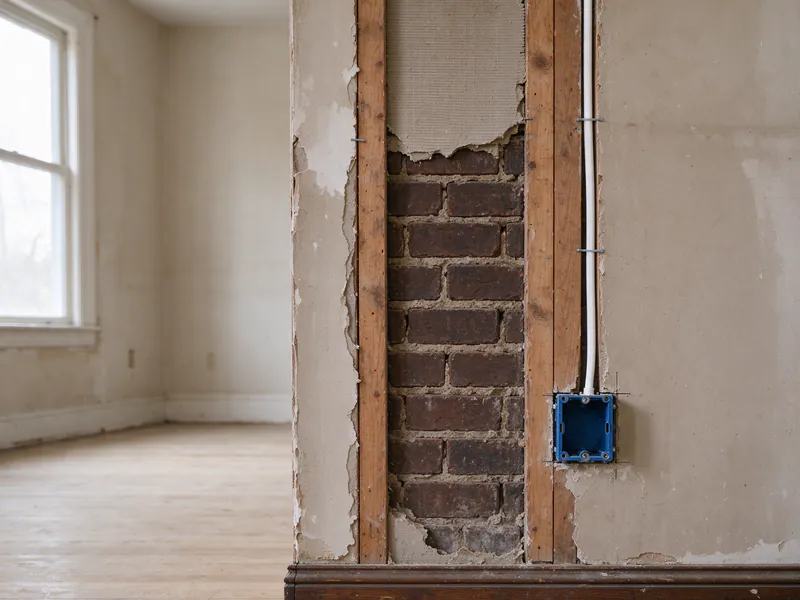
The inspector comes after we’ve run the new cable and set the boxes, and before anyone patches an opening. They look at the cable type and how it’s supported, box fill, how cable enters each box, protection where it passes through framing, and the routes back to the panel.
What gets tested before the final?
Before the final, we test every circuit: continuity, polarity, a working ground on every grounded device, and GFCI and AFCI devices tripping as they should. The inspector then checks devices, breaker sizes against the wire, labels and the panel. Our testing is what lets the work pass; the permit final is your record that it did.
What if something fails?
A failed rough-in or final means a return trip at $40. The bigger cost is time: your walls can’t close until IBI passes the work, so a failed rough-in holds up patching. We plan plaster-wall rewiring with that wait built in.
What if someone starts without one?
It costs more, not less. IBI charges double for work in progress without a permit (its schedule notes “to $200”), and the City adds an investigation fee equal to the regular permit fee.
The bigger bill comes later. Buyers’ inspectors, insurers and lenders ask for permit records, and the paperwork insurers read starts with the permit final.
What if you live outside the city, or in Kentucky?
Most of Hamilton County still uses IBI for electrical permits, but the way in differs. Each suburb has its own building department, and the City’s contractor registration doesn’t apply there. We confirm the route for every address before we plan the work.
| Place | Electrical permits and inspection | How sure |
|---|---|---|
| Unincorporated Hamilton County | IBI | Stated by Hamilton County |
| Deer Park | IBI, though the city runs its own building office | Stated by Deer Park |
| Norwood | Reported to be IBI, through the city-contracted agency | Not confirmed at the source; confirm per address |
| Wyoming | Reported to be IBI | Not confirmed; confirm per address |
| Blue Ash | Reported to issue its own | Not confirmed; confirm per address |
| Covington and Kenton County PDS areas | Kentucky permit, IBI inspections | Stated by IBI |
| Bellevue, Dayton, Fort Thomas | IBI inspections | Stated by IBI |
| Newport | Not on IBI’s list; Newport has its own building official | Confirm per address |
Kentucky runs on its own code timetable. The Kentucky Department of Housing, Buildings and Construction began mandatory enforcement of the 2023 NEC on January 1, 2025. For an address the table doesn’t settle, the state says to ask the county judge-executive’s office or the city office.
How do you know your permit closed?
Ask for the permit number before work starts and the final certificate when it ends. Together they prove IBI inspected the rewire, and they belong in your house file next to the circuit map.
Ready to start a permitted rewire? Call (513) 496-2715 or use the form below. Our guides to whether K&T is illegal in Ohio and how replacement works pick up from here.