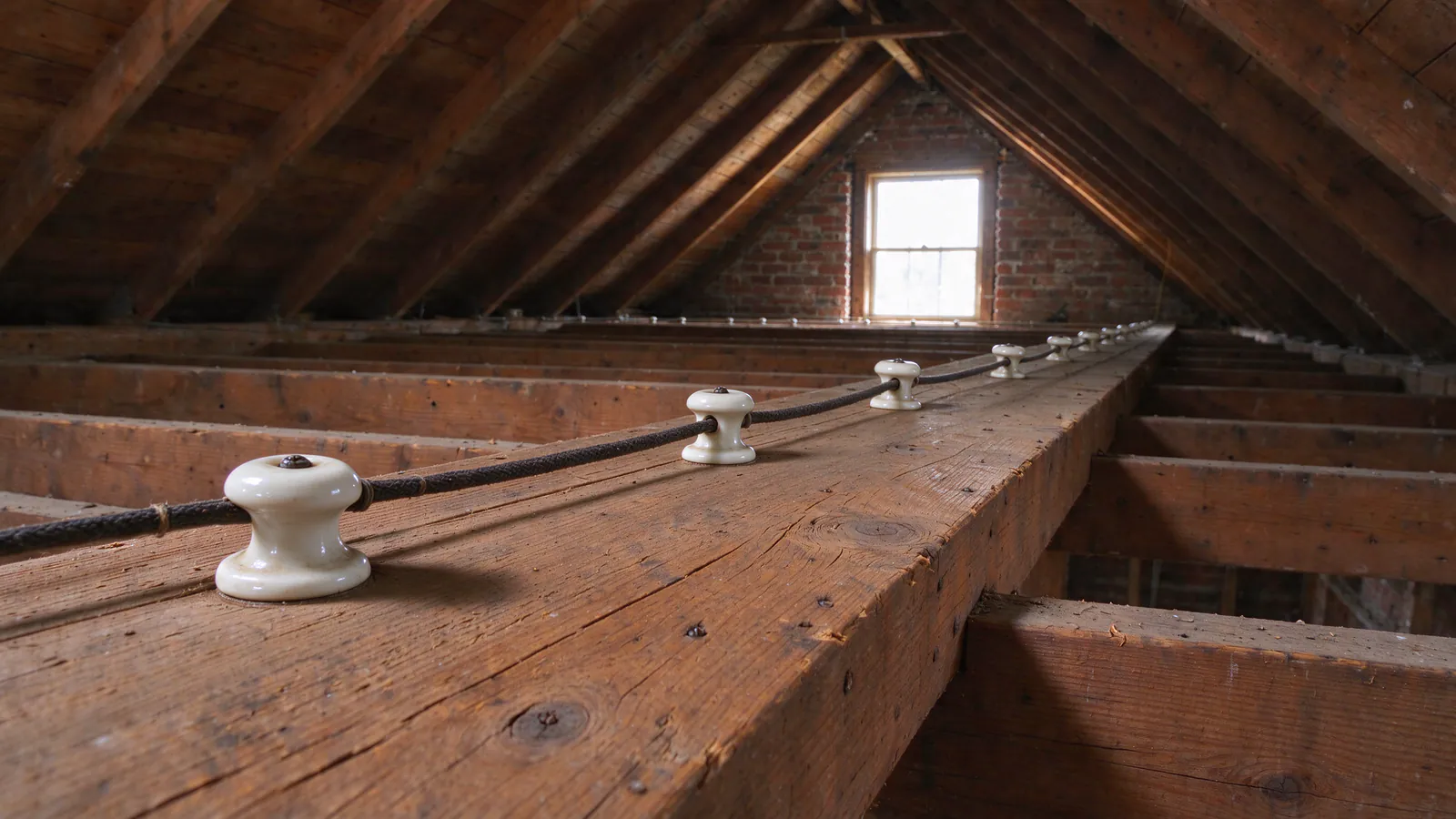
Do you have to rip it out?
No, not because of the law. When people ask “is knob and tube illegal in Ohio”, they’re usually asking three things at once: can the wiring stay, what rules does new work follow, and what will an insurer or lender demand.
Each has a different answer, and only the second is really about the electrical code. At Conflux Cincinnati Knob and Tube we replace K&T under permit in Cincinnati, Hamilton County and Northern Kentucky. Here’s what the rules say, and where the answer depends on an official, an insurer or a lender.
| Your question | Short answer | Who decides |
|---|---|---|
| Can existing, unaltered K&T stay in service? | Generally, yes; Ohio code doesn’t order it removed | Code officials, if they cite a hazard |
| What do new circuits and alterations follow? | The 2023 NEC as adopted by Ohio | IBI in Cincinnati and much of Hamilton County |
| Will an insurer or lender accept it? | Each sets its own terms | The carrier or lender |
Which code covers your house?
If you live in a one- to three-family home in Ohio, the Residential Code of Ohio. Its electrical chapter, Ohio Administrative Code 4101:8-34-01, takes in NFPA 70, the National Electrical Code, with Ohio’s own amendments.
Since April 15, 2024, that’s been the 2023 NEC, replacing the 2017 edition. Ohio made eight amendments, including changes to the GFCI rules in Section 210.8 and to surge-protection provisions. Earlier versions of the rule took effect January 1, 2013, January 1, 2016 and July 1, 2019.
What if your building is larger?
Buildings of four or more units, and commercial buildings, follow the Ohio Building Code instead. It also lists the 2023 NEC, with one Ohio exception on a GFCI provision. Two-family and rental rewiring covers how a multi-unit building changes the job.
What does the code say about the K&T already there?
A code edition governs the work done under it. Wiring that was legal when it went in is generally allowed to stay unless someone alters it or an official finds it hazardous, and Ohio has no provision that overrides that for knob and tube.
The NEC still has an article for concealed knob and tube, Article 394. It’s generally read to allow K&T only for extending existing installations, and to bar it in hollow spaces where loose, rolled or foamed-in-place insulation surrounds the wires.
When does the code catch up with your old wiring anyway?
The moment work touches it. Three situations bring K&T under the current code even when nobody set out to replace it.
- Extending or splicing a circuit. Joining new cable to K&T is an alteration, and IBI inspects it under the 2023 NEC; see K&T spliced into Romex.
- Insulating around it. Blowing insulation into a space with live K&T runs into Article 394’s insulation limits; see attic insulation.
- Replacing devices. A new receptacle on an ungrounded circuit has its own code options and labels; see grounding.
What have you heard that isn’t quite right?
Plenty of what gets said about K&T and the law is half right. These four claims come up often, and each one steers a decision the wrong way.
| What you may have heard | What’s actually the case |
|---|---|
| “Ohio law requires all knob and tube to be removed.” | Ohio code doesn’t order existing, unaltered K&T removed; the pressure usually comes from insurers and lenders. |
| “K&T was there first, so insulation can go over it.” | Insulating is new work, and Article 394 is generally read to bar burying K&T in insulation. |
| “A new breaker panel brings the house up to code.” | A panel change covers the panel. The branch circuits, K&T included, stay as they were. |
| “Three-prong outlets make an old circuit compliant.” | Without a ground behind them, they need GFCI protection and labels under the code’s options. |
Can you get an official to look?
Yes. If you want an official view of your existing wiring rather than a contractor’s, IBI’s fee schedule lists a survey of a one- to three-family residence at $40 for the first unit, plus the $60 processing fee. Ask IBI what the survey covers before you book it, since it isn’t the same as a circuit-by-circuit assessment.
Who’s allowed to do the work, and does it need a permit?
Any rewire, extension or panel change needs an electrical permit. In Cincinnati, Inspection Bureau, Inc. issues and inspects them, and its rule is that any work installing or altering wiring or equipment needs one.
Ohio Revised Code 4740.13 bars anyone from acting as an electrical contractor without an OCILB license, and Cincinnati also requires contractor registration. Our guide to the Cincinnati electrical permit covers the process and fees.
What if you’re across the river in Kentucky?
Then Ohio’s rules don’t apply. Kentucky runs its own code adoption and licensing. Kentucky’s Department of Housing, Buildings and Construction began mandatory enforcement of the 2023 NEC on January 1, 2025, with some provisions for one- and two-family homes phased in until July 15, 2026.
In Covington or Newport, your house follows Kentucky’s code, licensing and permit route, and we plan those jobs to Kentucky’s rules.
So why is everyone telling you to replace it?
Because most K&T gets replaced for reasons outside the code book. Your insurer asks whether it’s active, a buyer’s inspector writes it up, or a lender attaches a condition. Each sets its own terms, and those are often stricter than any law.
- Insurers. Each carrier writes its own rules; see K&T insurance in Ohio.
- Sellers. Ohio’s disclosure form asks about known electrical problems; see disclosure in Ohio.
- Safety. Legal isn’t the same as safe; see whether K&T is dangerous.
How do you get a straight answer for your house?
“Legal” only tells you whether you must act. Whether you should depends on what your circuits are doing, and tracing shows that. On a knob and tube inspection we write down every circuit and its status.
To talk it through, call (513) 496-2715. Our primer on knob and tube explains the system these rules are written about.