
GFCI, AFCI: which one does your old wiring need?
You’ve got two-prong outlets on knob and tube and someone suggested GFCIs, or you fitted an AFCI and it keeps tripping. Both can go on old wiring, but they protect you from different things.
Knowing which does what is the first step to deciding whether either belongs on your circuit. At Conflux Cincinnati Knob and Tube we handle grounding work, protection upgrades and K&T replacement in Cincinnati, Hamilton County and Northern Kentucky. Here we compare the two devices; knob and tube grounding walks through the code’s options in detail.
| GFCI | AFCI | |
|---|---|---|
| Protects against | Electric shock to people | Fires started by arcing in wiring |
| How it works | Compares current leaving on the hot with current returning on the neutral; trips on a small difference | Watches the current’s pattern for the signature of an arc; trips when it sees one |
| Needs a ground? | No | No |
| Common forms | Receptacle or breaker | Breaker, or an outlet-branch-circuit receptacle |
| Usual trouble on K&T | Rarely trips without cause | Often trips on shared neutrals and old splices |
Can you put a GFCI on knob and tube?
Yes, and for a shock risk at an ungrounded outlet it’s the standard answer. A GFCI measures the current going out and the current coming back. If some is leaking, perhaps through you, it cuts power within a fraction of a second.
Because it compares hot and neutral, it needs no ground wire. That’s why the NEC lists GFCI protection as one of the options when someone replaces a receptacle on an ungrounded circuit.
What labels go on the outlet?
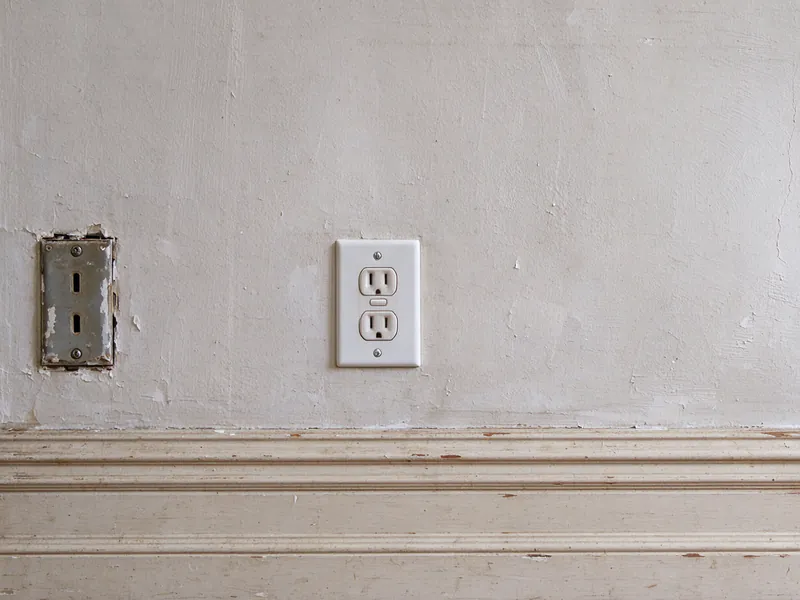
A three-prong outlet on an ungrounded circuit with GFCI protection gets a “No Equipment Ground” label. Outlets protected by a GFCI upstream also get “GFCI Protected”. The labels tell the next person that the third slot is there for the plug, not for a ground.
What won’t a GFCI do for you?
It won’t give your computer or surge protector the ground it needs, and a GFCI-protected outlet labeled this way can’t supply a ground to other outlets. It also does nothing about heat in the wire itself.
Does an AFCI help on knob and tube?
It can. An arc-fault circuit interrupter looks for the electrical signature of arcing: a loose splice, a cracked wire or a nail through a wire. Those arcs can start fires without ever drawing enough current to blow a fuse.
On paper that suits old wiring well. In practice AFCIs on K&T circuits often trip, and the cause is usually the circuit, not the device.
Why does your AFCI keep tripping?
Because old wiring breaks rules the AFCI relies on. An AFCI expects each circuit’s neutral current to come back on its own neutral, and knob and tube often doesn’t do that.
- Shared neutrals. One neutral can serve two circuits, or someone tied one circuit’s neutral into another, especially during later alterations.
- Old splices. Loose or corroded soldered joints can make the small arcs the device is built to catch.
- Period switch wiring. Some old three-way and switch setups connect wires in ways today’s code no longer allows.
A trip that keeps coming back is telling you something: there’s a fault worth tracing. Swapping in a plain breaker to stop it removes the warning, not the cause.
Where can the protection go in your house?
Your panel decides part of the answer. Protective breakers only fit a breaker panel that accepts them, so if you’re still on screw-in fuses you have fewer choices.
| Form | Where it goes | Fits a fuse box? | Note |
|---|---|---|---|
| GFCI receptacle | At an outlet, protecting it and those after it | Yes | Needs the outlet order known, which tracing gives |
| GFCI breaker | In the panel, protecting the whole circuit | No | Needs a compatible breaker panel with space |
| AFCI breaker | In the panel | No | Most likely to expose shared neutrals |
| Outlet-branch-circuit AFCI receptacle | At the first outlet of a circuit | Yes | Protects downstream wiring, not the run back to the panel |
| Dual-function breaker | In the panel, both protections | No | Same neutral issues as an AFCI |
If the fuse box itself is what’s holding you back, our guide to 200-amp service explains how panel and service decisions relate to the branch wiring.
When does the code require them?
When you do work, not because the house is old. The 2023 NEC, which Ohio adopted for one- to three-family homes on April 15, 2024, sets where each device is required on new and modified circuits, and Ohio amended some GFCI provisions in Section 210.8.
Two things follow for you:
- Changing a circuit can bring AFCI rules with it. The NEC generally requires AFCI protection where someone modifies, replaces or extends branch-circuit wiring in covered rooms, with limited exceptions. We confirm the specifics for your job with IBI.
- Replacing a receptacle has its own rules. Swapping a device on an ungrounded circuit follows the options and labels above.
Kentucky follows its own adoption of the 2023 NEC, with certain GFCI items delayed pending a revised product standard. Our Covington and Newport pages cover the Kentucky side.
Is a device a stopgap or the real fix?
GFCI and AFCI protection can make a sound K&T circuit safer while you plan. They can’t fix a damaged one. Find your situation in the table.
| Your situation | Reasonable step |
|---|---|
| Intact K&T, correct fuses, outlets used for lamps and phones | GFCI protection and labels as a stopgap |
| Electronics or three-prong appliances on the circuit | A grounded circuit, usually through partial replacement |
| AFCI trips again and again | Trace the circuit; shared neutrals or bad splices usually need rewiring |
| Brittle insulation, buried runs or splices into newer cable | Replacement; no device fixes these |
| A fuse panel with no room for new breakers | Panel work, covered under fuse box replacement |
Our guide to repair or replacement covers the bigger decision.
What should happen before anyone fits a device?
Someone needs to know what each circuit feeds. Without tracing, a GFCI can end up protecting the wrong outlets, and an AFCI can take the blame for a fault it found correctly.
On a knob and tube inspection we trace every circuit first. To ask about protection for your house, call (513) 496-2715. Our guide on whether K&T is dangerous explains the faults these devices are meant to catch.