Should you be worried about the wiring in your house?
Is knob and tube wiring dangerous? Honestly, it depends on the circuit. At Conflux Cincinnati Knob and Tube we assess and replace this wiring in Cincinnati, Hamilton County and Northern Kentucky, and we trace before we advise.
The system was a sound design for the loads it was built for. What wears it down is a short list of conditions, most of them added by time or by later owners. Below we explain each one, how it creates a hazard, and what fixes it.
How does old insulation end up exposing bare copper?
The rubber is the part that ages. Each K&T wire is copper wrapped in rubber, with a cotton braid outside. Heat and time harden the rubber, and once it’s hard it cracks when it moves.
Here’s how age turns into a hazard:
- Heat and time harden the rubber. The worst spots are inside ceiling boxes above lamps, where heat has built up for decades.
- Hard rubber cracks. Any movement, from a fixture change to an electrician pulling a wire, can split it.
- Pieces fall away. The braid often holds its shape, so the wire looks covered after the rubber under it is gone.
- Copper is exposed. Bare copper near wood, a metal box or the other wire is where shock and arcing start.
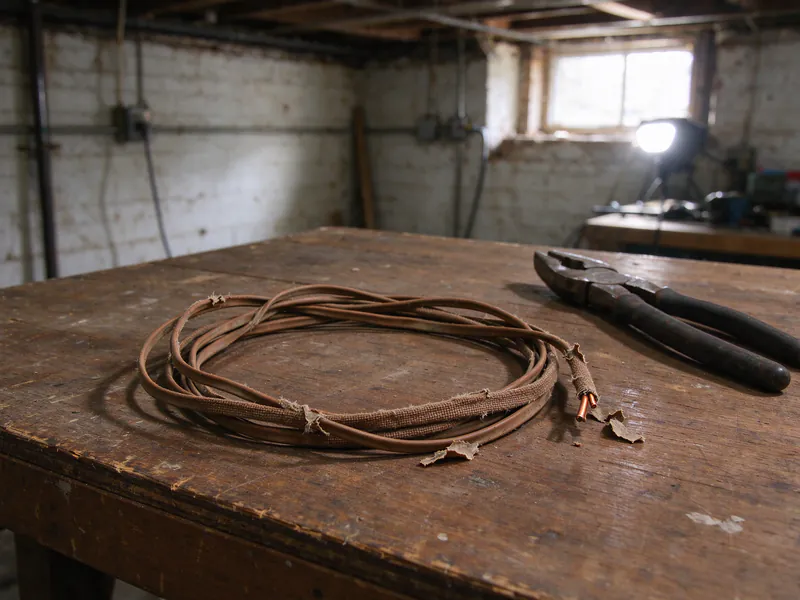
That’s why nobody should handle suspect wiring to “check” it. Disturbing brittle insulation is how it fails. On a knob and tube inspection we look at it where we can see it without moving it.
What happens when insulation is packed around it?
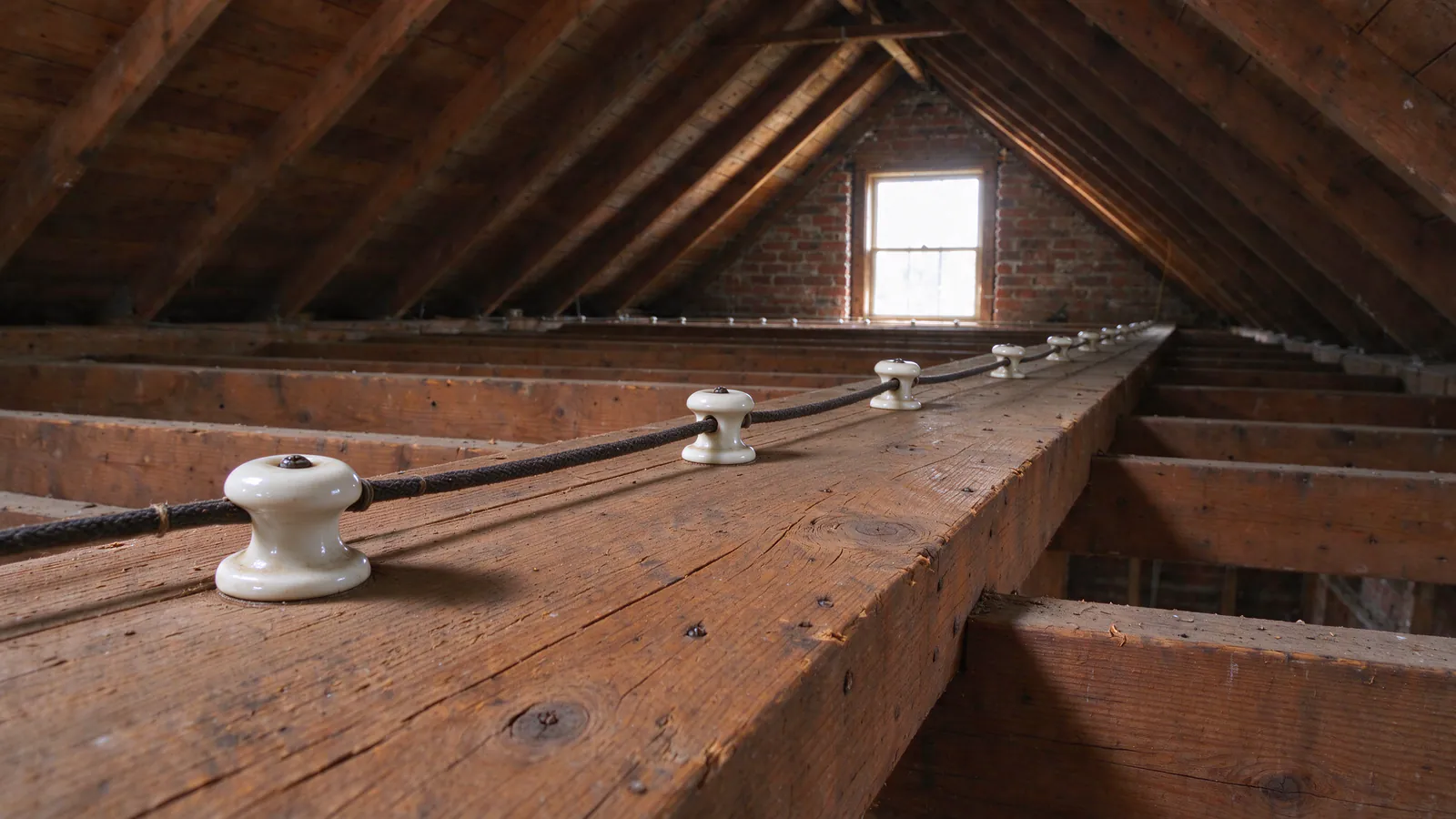
The heat has nowhere to go. Knob and tube was built to shed heat into open air: each wire hangs alone on its knobs, with air on every side. Pack insulation around it and the copper runs warmer at the same load.
Insulation blown into an attic years later can bury the original runs completely. NEC Article 394, the code article for concealed K&T, is generally read to bar these wires in hollow spaces where loose, rolled or foamed insulation surrounds them. The attic insulation page covers what we do before an attic gets insulated.
Why does a bigger fuse make things worse?
Because the fuse is the circuit’s only protection against too much current. When someone swaps a blowing fuse for a bigger one, the wire can carry more current than its insulation can stand, and nothing trips until the damage is done.
Overloading does the same thing from the other side. The original circuits were laid out for lamps and a few small appliances. A space heater, a window air conditioner or a kitchen full of appliances on one long circuit pushes it far past that.
| What’s going on | What it does to the wire | What fixes it |
|---|---|---|
| Fuse bigger than the wire allows | Lets current exceed what the insulation can stand | A correctly sized fuse or breaker, never bigger |
| Too many loads on one circuit | Heats the full length of the run | New circuits for heavy loads |
| Insulation packed around runs | Traps heat at ordinary loads | Replacing the circuit, or clearing it before insulating |
| Taped splices to newer cable | Creates hidden hot spots | Opening, boxing or replacing the circuit |
Our guide to warning signs lists the symptoms that tend to point at each of these.
Where does most of the risk actually come from?
From later work, more than from the original installation. Over the years owners extended circuits, added outlets and spliced new cable onto old wire, often with tape and no box, hidden in a wall or ceiling.
Those joints are where loose connections arc and heat up. They also hide K&T inside circuits that look modern. Our guide to K&T spliced into Romex explains why insurers and inspectors care about that mix.
What about the missing ground?
K&T has no ground, so a fault in a metal appliance has no safe path. Three-prong outlets fitted later don’t change that. GFCI protection can lower the shock risk without a ground; our guide to AFCI and GFCI on knob and tube sets out what each device does and doesn’t do.
What’s urgent, and what can wait?
Not every circuit carries the same risk, so your response shouldn’t either. Sort what you know into the two lists below, and act on the first one now.
When should you call an electrician right away?
- A burning smell, scorching, or heat at a cover plate or switch
- Buzzing or crackling from a switch, outlet or fixture
- A fuse bigger than the circuit should have, or fuses that keep blowing
- K&T you can see with damaged insulation or bare copper
When can you plan an assessment without panicking?
- K&T noted in a home inspection, with no symptoms
- Two-prong outlets and push-button switches that work normally
- Original runs in a basement that may already be disconnected
- An insurer asking whether the wiring is active
Federal safety sources such as the Consumer Product Safety Commission and the Electrical Safety Foundation International give the same general advice for old wiring: warmth, sparks and repeated tripping call for a qualified electrician, not a home repair.
How do we find out whether yours is dangerous?
Looking won’t tell you, because the risky parts hide in boxes, splices and attic insulation. Tracing does: we follow every K&T circuit to its fuse, check the fuse against the wire size and test the circuit live or dead.
You get a written circuit list: replace now, replace later, or already dead. Some houses need a whole-house rewire; many need partial replacement of a few circuits first. Our guide to active and abandoned K&T explains how we prove a run is dead.
If something from the first list is happening now, switch off that circuit at the panel if you can do so safely, and call (513) 496-2715. Our primer on knob and tube wiring covers how the system works, and repair or replacement covers what the fix can look like.