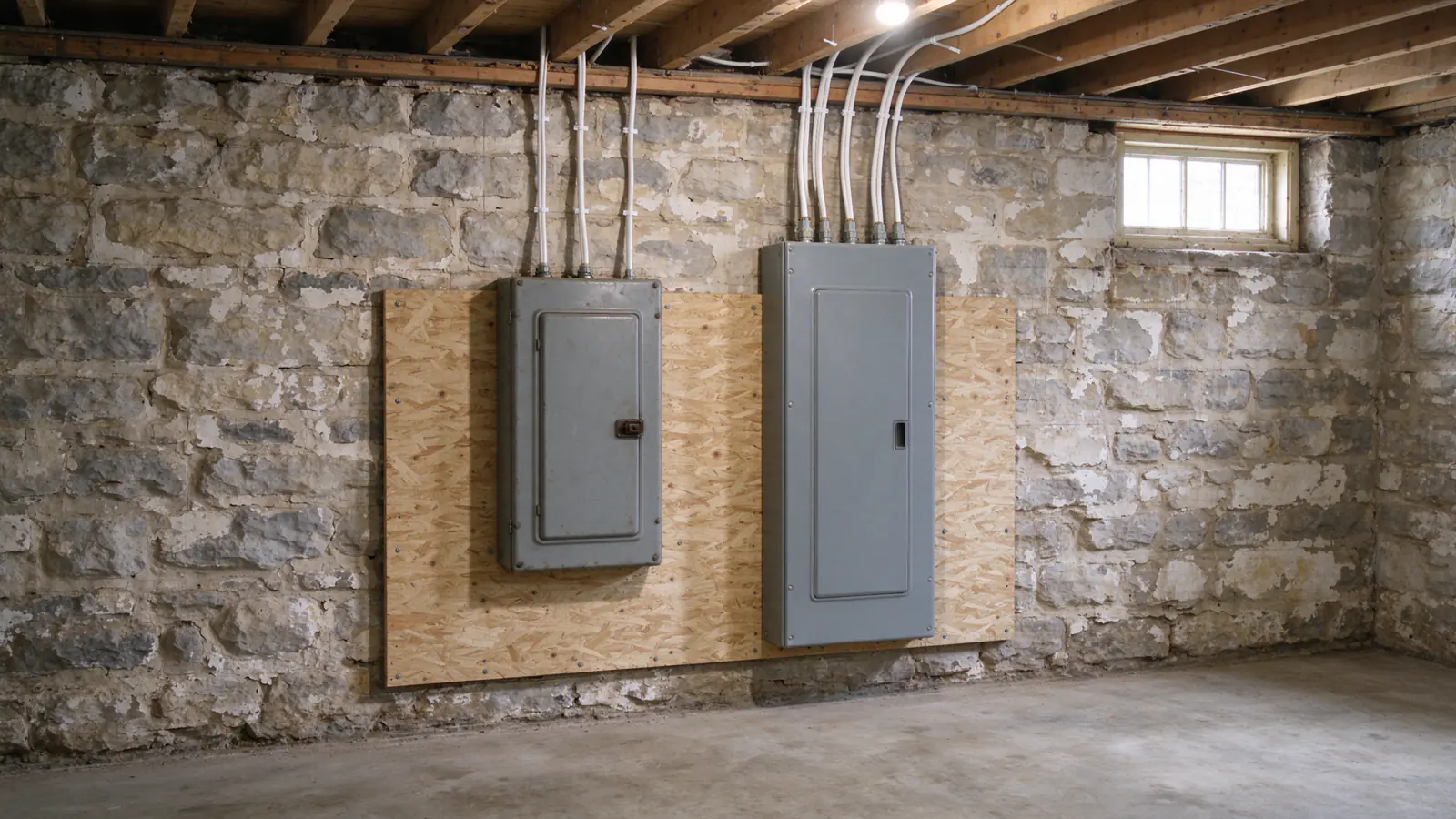
New 200-amp panel, old wiring: what does that mean for you?
It means one layer of your wiring got upgraded and the other didn’t. With knob and tube with 200 amp service, the service and panel decide how much power comes in; the branch circuits, still K&T, decide how it reaches each room.
At Conflux Cincinnati Knob and Tube we handle panel changes, service upgrades and K&T replacement across Cincinnati, Hamilton County and Northern Kentucky. Here’s how the layers relate.
| Layer | What it is | What sets its limit |
|---|---|---|
| Service | The utility’s connection, meter and service conductors | Its ampere rating, such as 100 or 200 amps |
| Panel | The fuse box or breaker panel that divides power into circuits | Its rating and the space it has for breakers |
| Branch circuits | The wiring from each fuse or breaker to outlets and lights | The wire size, its insulation and how it’s installed |
Why doesn’t a bigger service fix the K&T?
Because 200 amps means your house can draw more power in total. It does nothing to the wire running to the bedroom, and each original K&T circuit can still carry only what its wire and fuse allow.
That’s why a panel or service upgrade on its own isn’t K&T replacement. Insurers and inspectors who ask whether K&T is active get the same answer before and after. Our fuse box replacement page makes the same point about panel-only jobs.
Where is your house actually running short?
Usually on the circuits, not at the service. The original layouts gave a whole floor a few circuits, sized for lamps.
| What you notice | Likely layer | Why |
|---|---|---|
| One room’s fuse blows when the microwave runs | Branch circuit | Too much load for one old circuit |
| Lights dim across the house when the air conditioner starts | Service or panel, possibly | Large loads on a small service, or a loose connection |
| No space for new circuits in the panel | Panel | Every position is full |
| Plans for a heat pump, electric range or EV charger | Service, likely | Large new loads change the total |
These signs don’t prove a single cause, since a loose connection can imitate an overload. Our guide to warning signs covers what each one can mean.
Why not just fit a bigger fuse?
Because that takes away the protection the wire depends on. When an old circuit keeps tripping, a bigger fuse or breaker is the tempting fix. The fuse is meant to open before the wire overheats; a bigger one lets the wire overheat first.
Original K&T circuits usually use small-gauge copper, so they’re normally protected at a low rating. A panel upgrade is when we correct this: each old circuit lands on a breaker sized to its wire, which can mean more trips until we move loads to new circuits.
How do you know if you need a bigger service?
A load calculation under NEC Article 220 tells you, not a rule of thumb. It counts floor area, fixed appliances, heating and cooling, and the new circuits a rewire adds.
- Keep the service when the calculation fits the existing rating; only the panel may change.
- Upgrade the service when large loads push the total past it.
- Plan ahead if a heat pump, EV charger or electric range is likely in the next few years.
Ohio’s Residential Code has used the 2023 NEC since April 15, 2024, so for one- to three-family homes the calculation follows that edition.
Why do a rewire and a new panel so often go together?
They’re separate scopes, but they rarely stand alone. A rewire adds circuits, and new circuits need panel space and often AFCI or GFCI breakers that only a breaker panel takes.
So the order matters. If your panel will change, we plan it with the rewire, even if it goes in first. Our guide to how replacement works shows where the panel fits in the job, and AFCI and GFCI on K&T covers the breakers.
What changes outside the house with a service upgrade?
The utility gets involved, and so does your outside wall. In IBI’s territory, IBI inspects the upgraded service and then tells the utility to energize it.
- Fees. IBI lists a service-entrance inspection at $40 for the first dwelling unit and $30 for each more, plus the $60 processing fee on every permit.
- An outdoor disconnect. The 2023 NEC as Ohio adopted it includes an outdoor emergency disconnect provision for one- and two-family homes. How it applies to a service replacement is IBI’s call, so we check with IBI before we price the job.
- Historic districts. Equipment on the outside of a house in a Cincinnati local historic district can need a Certificate of Appropriateness; see rewiring in a historic district.
Which of these sounds like your house?
Most houses fall into one of a few patterns. Each points to a different order of work, and the service rating alone settles none of them.
| Your house | Usual order | Why |
|---|---|---|
| Fuse box, K&T throughout, no big new loads | Rewire and panel together; the service may stay | The panel has to change to take new circuits, but the total load may fit |
| 200-amp panel already, K&T still on some circuits | Partial replacement of the remaining circuits | The capacity is there; the branch wiring is the gap |
| K&T throughout, heat pump or EV charger planned | Whole-house rewire with a service upgrade sized for the plans | Doing both at once avoids reopening the panel later |
Two-family and three-family buildings add a meter and often a panel per unit, which our two-family rewiring page covers.
Where do you start?
With the branch circuits, then we size the panel and service around them. On a knob and tube inspection we trace every circuit and check fuse sizes against the wire, and the load calculation follows from what the rewire will add.
To compare panel-only and rewire scopes for your house, call (513) 496-2715. Our guide to comparing rewiring quotes shows how to read quotes that bundle the two.