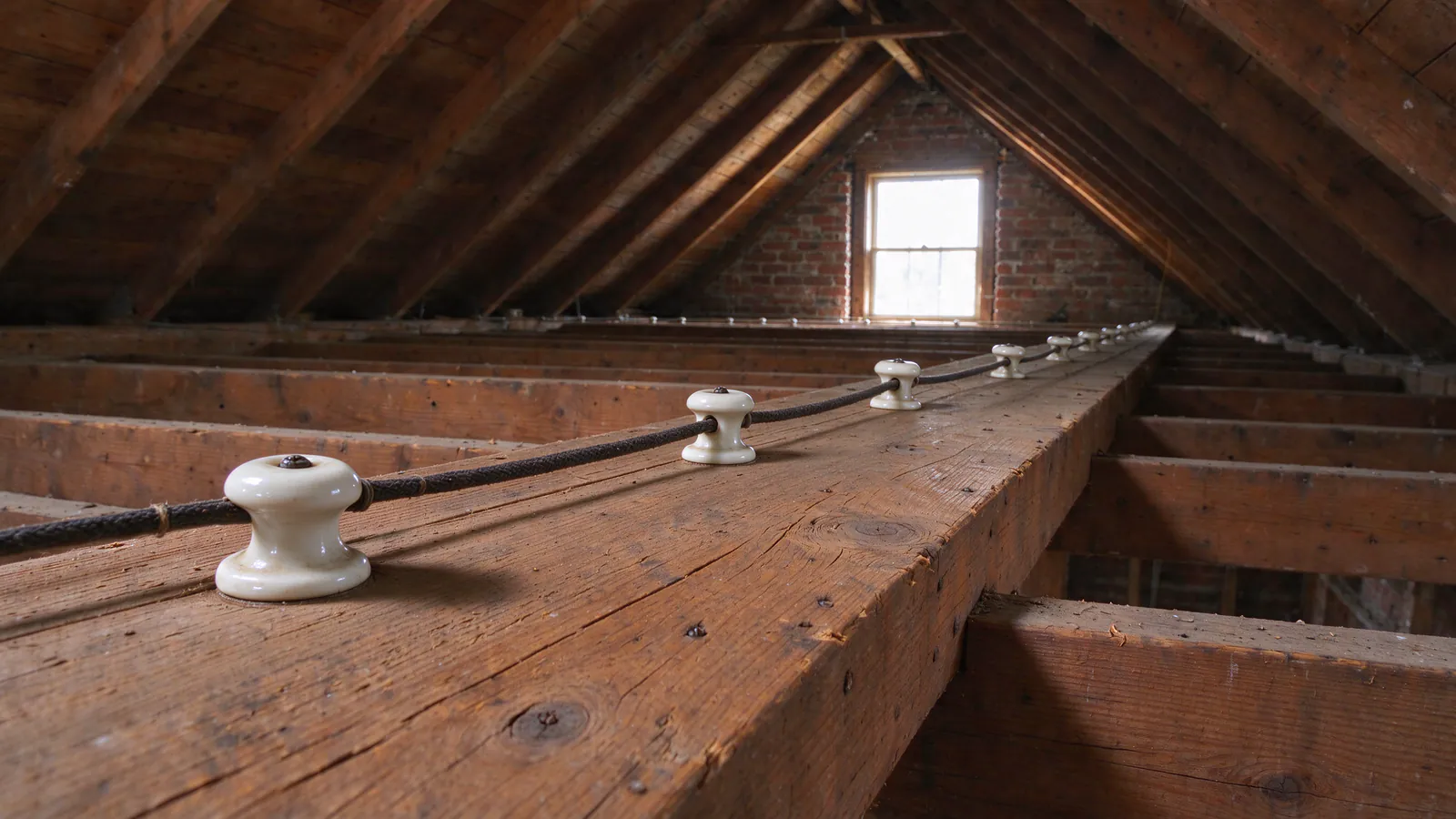
How do you know who to trust with your old wiring?
Start with what you can check, then ask the right questions. Hiring an electrician for knob and tube in Ohio has two parts, and the credentials are the easy one: they’re public and take minutes to look up.
Whether someone really knows old wiring takes a conversation, and the questions below keep it short. At Conflux Cincinnati Knob and Tube we assess and replace K&T across Cincinnati, Hamilton County and Northern Kentucky, and we’d rather you ask us these questions than not. Whoever you hire, the same checks apply.
What does Ohio require?
Ohio licenses electrical contractors through the Ohio Construction Industry Licensing Board (OCILB). Ohio Revised Code 4740.13 says no one may act as, or claim to be, an electrical contractor without that license.
| Requirement | Applies where | What to ask for |
|---|---|---|
| OCILB electrical contractor license | All of Ohio | The license number, checked with OCILB |
| City contractor registration | City of Cincinnati | Registration as an “OCILB Licensed Specialty Contractor” |
| Liability insurance, at least $100,000/$300,000 | Required for City registration | A certificate naming the coverage |
| Ohio workers’ compensation | Required for City registration | Proof of coverage |
| Electrical permit | Every rewire | The IBI permit number before work starts |
City registration costs $130 including surcharges, so a contractor who works in Cincinnati regularly will have it. Our Cincinnati electrical permit guide covers how the permit works.
What about county licenses and the suburbs?
Ohio law also lets boards of county commissioners license electrical contractors who don’t need a state license, so you may see more than one credential. For a rewire, ask for the OCILB license by number.
The City’s registration only applies inside Cincinnati. In suburbs such as Norwood, the local building department sets its own rules, so ask it or confirm for your address.
What if you live in Kentucky?
Kentucky runs its own electrical licensing and code adoption. In Covington or Newport, an Ohio license and a Cincinnati registration aren’t the credentials to ask about; ask for the Kentucky license number instead.
Can you do the work yourself?
Read the homeowner exemption carefully. If you own a one- to three-family home, do the work yourself and will live there at least a year, the City exempts you from contractor registration. That’s registration only.
The City says it issues permits only to properly licensed contractors, and IBI doesn’t publish a separate rule for homeowners. Ask IBI directly about a homeowner permit before you plan anything, and keep in mind that insurers and buyers read the permit record.
Which questions show real K&T experience?
General electrical skill isn’t the same as knowing old houses. These questions, and what a good answer sounds like, help you tell the difference.
| Ask | A good answer includes |
|---|---|
| How will you find which K&T is live? | Tracing each circuit to its fuse, testing at both ends, switches in every position |
| How do you plan routes in plaster? | Attic and basement first, then closets and fire blocks; openings counted per room |
| What happens to the old runs? | Disconnected at both ends, tested, tagged and photographed |
| How do you handle splices into newer cable? | Found during tracing, bypassed by new cable from the panel |
| What will you give me at the end? | Circuit map, panel directory, scope letter, disconnection record, permit final |
| How do we live here during the work? | One circuit kept live, heat kept on in winter, rooms sequenced |
Which answers should worry you?
Some answers are warning signs whatever the price. They point to a scope that leaves problems behind, or records your insurer won’t accept.
- “We don’t need a permit for this.” IBI requires one for any work that installs or alters wiring.
- “No walls will be opened.” An old house usually needs some openings, and a promise of none isn’t a plan.
- “A new panel takes care of the knob and tube.” A panel changes no branch wiring; see K&T and 200-amp service.
- “Three-prong outlets will ground it.” Not without a ground behind them; see grounding.
- “Your insurer will definitely accept it.” Nobody can promise a carrier’s decision.
- A price before anyone has traced the circuits. Without a circuit list, the price is a guess.
What if an insurer, lender or buyer is waiting on you?
Tell every electrician in the first conversation and show them the exact wording. Then the job gets scoped to satisfy that request, not some general idea of “done”.
- Insurer. Share the carrier’s letter, so the scope and final letter answer its exact questions. See K&T insurance in Ohio.
- Lender or appraiser. Share the condition in writing; see K&T and mortgages.
- Buyer. Share the inspection page and the closing date; see K&T before closing.
Before you sign, ask whether the schedule, inspection steps included, fits the deadline.
What should you have in hand when the job ends?
Put these in the contract, so they arrive with the final invoice rather than after a reminder:
- The IBI permit number and final certificate
- A circuit map showing every circuit and its status
- A labeled panel directory
- A scope letter stating what was replaced, what was disconnected and whether any K&T remains
- A disconnection record with photos of retired ends
- The openings list, with the patching scope
Keep them with your house records. A buyer, an insurer or a future electrician will ask for them.
How do you compare the people, not just the price?
Two quotes can differ because two electricians read your house differently. Before you compare numbers, compare what each one found: how many live circuits, where the openings go, what remains.
Our guide to comparing rewiring quotes lines quotes up by scope, and the cost guide explains what moves a price. If an insurer is involved, the paperwork guide shows the records to ask for up front.
Ready to talk to someone?
A first visit should end with a written circuit list, not just a number. To arrange ours, call (513) 496-2715 or use the form below. Our guide to preparing for a rewire covers what to gather before anyone arrives.