What exactly is behind your walls?
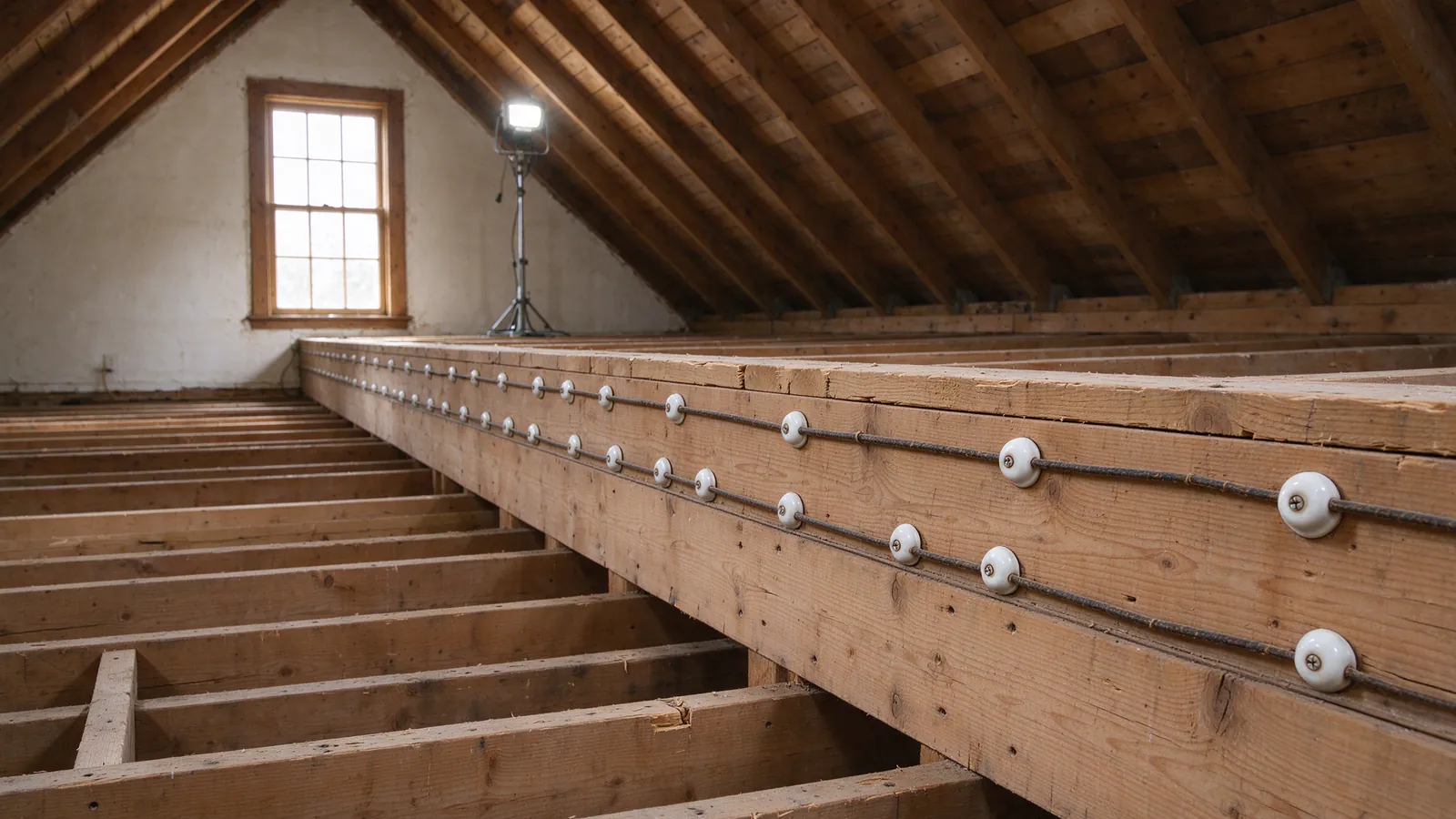
Seen pairs of old wires on white porcelain in your basement, or an inspection report that says “knob and tube observed”? That’s knob and tube wiring: each circuit is two single wires, a hot and a neutral, run apart through the framing, with no ground.
At Conflux Cincinnati Knob and Tube we assess and replace this wiring across Cincinnati, Hamilton County and Northern Kentucky. This guide walks you through the system itself, so the decisions you face about it make sense.
Why is so much of it still in Cincinnati?
Because the houses are old, and almost nobody rewired them all at once. Knob and tube was the usual way to wire a house before the 1940s, and owners since have tended to add and patch, so the original circuits often stayed in service.
Cincinnati has a lot of those houses. Census figures put 40.3% of the city’s housing units in buildings from 1939 or earlier, more than three times the 11.9% national share. In some neighborhoods it’s higher still: 72.9% in Over-the-Rhine, by estimates aggregated from census tracts.
| Area | Housing units built 1939 or earlier |
|---|---|
| United States | 11.9% |
| Hamilton County | 24.4% |
| City of Cincinnati | 40.3% |
| Over-the-Rhine | 72.9% |
Source: U.S. Census Bureau, American Community Survey 2019-2023. Your house’s age tells us where to look. It doesn’t tell us what’s behind the walls today.
How does knob and tube actually work?
The whole idea is separation. Each circuit’s hot and neutral run a few inches apart, and clear of the wood. The air around each wire carries off the heat the current makes.
When we open a basement ceiling or an attic floor, these are the parts you’ll see, and each has one job:
| Part | What it does |
|---|---|
| Knob | A porcelain insulator nailed to a joist or stud. The wire wraps around it, held off the wood where it runs along the framing. |
| Tube | A porcelain sleeve set in a hole bored through a joist or stud, so the wire passes through the wood without touching it. |
| Loom | A flexible woven sleeve slipped over the wire where it enters a box, a fixture or a tight spot, as extra protection. |
| Conductor | A copper wire insulated with rubber under a cotton braid. |
| Splice | A joint the original electrician twisted, soldered and wrapped in tape, out in the open air. |
Because the two wires run separately, a circuit could branch almost anywhere along its route. The original electricians left splices in open joist bays rather than in boxes, and one run might feed lights and outlets in several rooms.
How were the original circuits laid out?
Few and long. A whole house might have had only a handful of circuits, each feeding lights and outlets in several rooms, because the people who wired it expected lamps and a few small appliances.
Each circuit started at a fuse in a panel near the service. Some older fuse panels fused both the hot and the neutral, and that brings a hazard of its own: if the neutral fuse blows, the circuit stops working but the wiring can stay energized.
Why do the switches and lights act strangely?
Old switch wiring can be unusual. Some three-way switch setups from that period connect wires in ways today’s code no longer allows, which is one reason an arc-fault device can keep tripping on a K&T circuit.
Where do the circuits run?
Through the open spaces: along basement joists, across the attic floor and down through stud bays. That’s why you see K&T in the basement and attic while the same circuits stay hidden inside finished walls. Our guide on how to identify knob and tube wiring shows you what to look for.
What did it do well?
For the loads it was built for, quite a lot. Copper wire, porcelain supports and open-air cooling gave it real margin, and plenty of it is still carrying current many decades on.
- It sheds heat. With air on all sides, each wire stays cool, as long as nothing is packed around it.
- The supports last. Porcelain doesn’t rot or burn, so the knobs and tubes are often in better shape than the wire they hold.
- The wires are apart. With hot and neutral inches apart, a fault between them is less likely than in a cable where they lie side by side.
- The joints were soldered. A good soldered splice is solid, mechanically and electrically.
Those strengths depend on conditions that later decades often changed: insulation blown into the attic, newer cable spliced in, heavier appliances and bigger fuses.
Where does it fall short today?
In three ways: what the system never had, what age has done to it, and what later owners did to it. You can’t see any of them from a single outlet.
| What’s wrong | Why it matters to you |
|---|---|
| No ground | Your three-prong appliances and surge protectors have no ground path, and a three-prong outlet fitted later doesn’t create one. |
| Aging insulation | Rubber hardens and cracks with age and heat, worst at hot ceiling fixtures. Once brittle, it can flake off when someone disturbs it. |
| Few, long circuits | A kitchen, a bathroom or a window air conditioner can load an old circuit far beyond what it was laid out for. |
| Insulation contact | Blown or batt insulation packed around the wires stops the open-air cooling the system depends on. |
| No modern protection | No arc-fault or ground-fault protection, unless someone has added it since. |
| Alterations | Splices to newer cable, oversized fuses and missing knobs add risks the original design never had. |
If you need to make an ungrounded circuit safer before we replace it, see your grounding options and our guide to GFCI and AFCI on old wiring.
Can you spot it without touching anything?
Often, yes. Look at the open joists in your basement and, from the attic hatch, across the attic floor. Pairs of single wires a few inches apart on white porcelain knobs, or passing through porcelain tubes, are the giveaway.
Other clues point toward it without proving it:
- Two-prong outlets throughout the house
- Push-button wall switches
- A fuse panel with screw-in fuses
- Cloth-covered wire visible at a fixture or in the basement
Your house can show none of these clues and still have K&T, because later owners often swapped the outlets and the panel while the original wire stayed in the walls. Our assessment quiz helps you sort out what you’ve seen.
Is yours live, dead or a mix?
Every bit of knob and tube in a house is in one of three states, and which one decides both the risk and the scope. Your insurer will usually ask about the first.
- Active. Still connected and energized, carrying current to lights or outlets today.
- Abandoned. Disconnected at its source and left in place. We only call it abandoned once we’ve disconnected it at both ends, tested it and written it down.
- Mixed. Some original circuits live, some dead, some partly replaced or spliced into newer cable. Many houses are like this.
A grey, tired-looking run in the basement can still be live, and a modern-looking house can feed a ceiling light through original wire. A non-contact tester held near a wire can miss a circuit that happens to be switched off.
Our guide to active versus abandoned K&T explains how an electrician proves a run is dead, and knob and tube removal covers how we close it out.
What actually makes it fail?
Age by itself rarely does. Problems come from specific conditions, and each one calls for a different fix.
| What happens | Why it causes trouble |
|---|---|
| Heat at fixtures | Years of heat from lamps make the rubber brittle at the box, where it can crack and expose the wire. |
| Buried in insulation | Insulation around a wire traps the heat open air used to carry off. |
| Overfusing | A fuse bigger than the wire allows lets it carry more current than its insulation can stand before anything trips. |
| Splices to newer cable | Joints hidden in walls and ceilings, often taped instead of boxed, become weak points. |
| Physical damage | Rodents, renovation work or a missing knob can leave a wire damaged or resting on wood. |
| Overload | Modern appliances on a few long circuits push current through wire sized for lamps. |
When should you book an assessment soon?
- Heat at a cover plate or switch, or a burning smell
- Fuses that keep blowing, or a history of bigger fuses fitted to stop it
- Lights that flicker or dim on one circuit only
- K&T under attic insulation, or insulation about to go in
When can you plan without panicking?
- Intact runs on correctly sized fuses, carrying light loads
- Visible K&T in the basement that may already be disconnected
- A line in an inspection report, with no symptoms
None of these signs proves a single cause, since a loose device or an overloaded circuit on newer wiring can do the same. Our guides to warning signs and whether knob and tube is dangerous go deeper.
Do Ohio rules make you remove it?
No. In Ohio, one- to three-family homes follow the Residential Code of Ohio, which has used the 2023 NEC since April 15, 2024. New work and alterations have to meet it, but Ohio code doesn’t order existing, unaltered knob and tube removed.
The NEC still limits it. Article 394, the NEC article for concealed knob and tube, is generally read to allow it only for extending existing installations, and to bar it in hollow spaces where loose, rolled or foamed-in-place insulation surrounds the wires. Before you rely on the details, we confirm them with the inspection authority for your address.
- Permits. In Cincinnati, Inspection Bureau, Inc. issues and inspects electrical permits. Any work that installs or alters wiring needs one, and IBI inspects the rough-in before the walls close.
- Who can do the work. Ohio law bars anyone from acting as an electrical contractor without an OCILB license, and the City of Cincinnati also requires contractor registration.
- Kentucky. Northern Kentucky follows Kentucky’s own code adoption, which began mandatory enforcement of the 2023 NEC on January 1, 2025.
Our guides to whether K&T is illegal in Ohio and the Cincinnati electrical permit cover the details.
Why is your insurer, buyer or lender asking?
Because most replacement decisions start outside the house. Your insurer asks whether the wiring is active, a buyer’s inspector writes “knob and tube observed”, or a lender makes the repair a condition of the loan.
Ohio has no statewide insurance rule on knob and tube; each carrier sets its own underwriting. Cincinnati homeowners report brokers who had no carrier willing to write a house with active K&T. A finished, permitted rewire gives an underwriter better evidence to work from, though no work can guarantee a particular answer.
If you’re selling, the question is different. Ohio’s Residential Property Disclosure Form asks about known problems or defects with the electrical system and about repairs in the past five years; it doesn’t name knob and tube. See insurance in Ohio, disclosure in Ohio and knob and tube before closing.
What happens when we assess your house?
We answer what a look around can’t: which circuits you have, which are live, and what shape they’re in. Every scope and every price depends on this step.
- We match each fuse or breaker to what it feeds and check its size against the wire.
- We follow the runs we can reach in the attic and basement and note splices, insulation contact and damage.
- We test which circuits are energized, and we confirm anything that looks dead at both ends.
- We check devices for heat damage and for three-prong outlets with no ground behind them.
- You get a written list showing each circuit as active, abandoned or mixed, with the scope we recommend.
Nobody can fully see wiring inside closed walls, so our report tells you what we verified, what we inferred from testing, and what would need access to confirm. You can book this visit on its own as a knob and tube inspection.
Repair, part of the house, all of it, or just the panel?
Those are the four scopes people weigh, and they’re easy to mix up. The right one depends on what the assessment finds, not on how much porcelain you can see.
| Scope | What it changes | When it fits |
|---|---|---|
| Targeted repair | One damaged section, splice or device | The damage is local, the rest of the circuit is sound, and nobody is asking for removal |
| Partial replacement | Chosen circuits, with a written boundary around the rest | K&T covers part of the house, or a remodel opens one area |
| Whole-house rewiring | Every branch circuit | K&T runs through most rooms, or has been spliced into newer cable |
| Fuse box replacement | The panel and its protection | The panel itself is the problem; it removes no K&T |
Our guide to repair versus replacement covers when a repair is reasonable, and the Cincinnati cost guide explains what moves the price of each scope.
What does replacement look like in your house?
We swap each K&T circuit for new grounded cable, one circuit at a time, while you keep living there. Most of the work happens from the attic and basement.
- We make the circuit map and arrange the IBI permit.
- We plan routes from above and below, and protect your floors and furniture.
- We shut off one circuit at a time, fish new cable and set or replace boxes.
- IBI inspects the rough-in before any wall or ceiling closes.
- Devices go in, each circuit lands on a correctly sized breaker, and we test and label it.
- We disconnect the old runs at both ends and record them, and the final inspection follows.
In a plaster house, planning the routes is most of the skill. Plaster-wall rewiring explains how we keep openings few and patchable, and the replacement, step by step follows a job from start to finish.
How do you live with it while you plan?
Many owners live with knob and tube for a while before replacing it, and a few habits lower the risk in the meantime. None of them involves touching the wiring.
- Keep heaters, window air conditioners and kitchen appliances off the old circuits where you can.
- Never fit a bigger fuse to stop one blowing. A blowing fuse is the circuit protecting itself.
- Keep new insulation away from attic runs until someone has assessed them.
- Ask an electrician about GFCI protection for ungrounded outlets as a stopgap.
- Book an assessment before your insurer’s deadline or an inspection contingency runs out.
Want to talk through your house? Call (513) 496-2715. If price is your next question, read the Cincinnati cost guide.