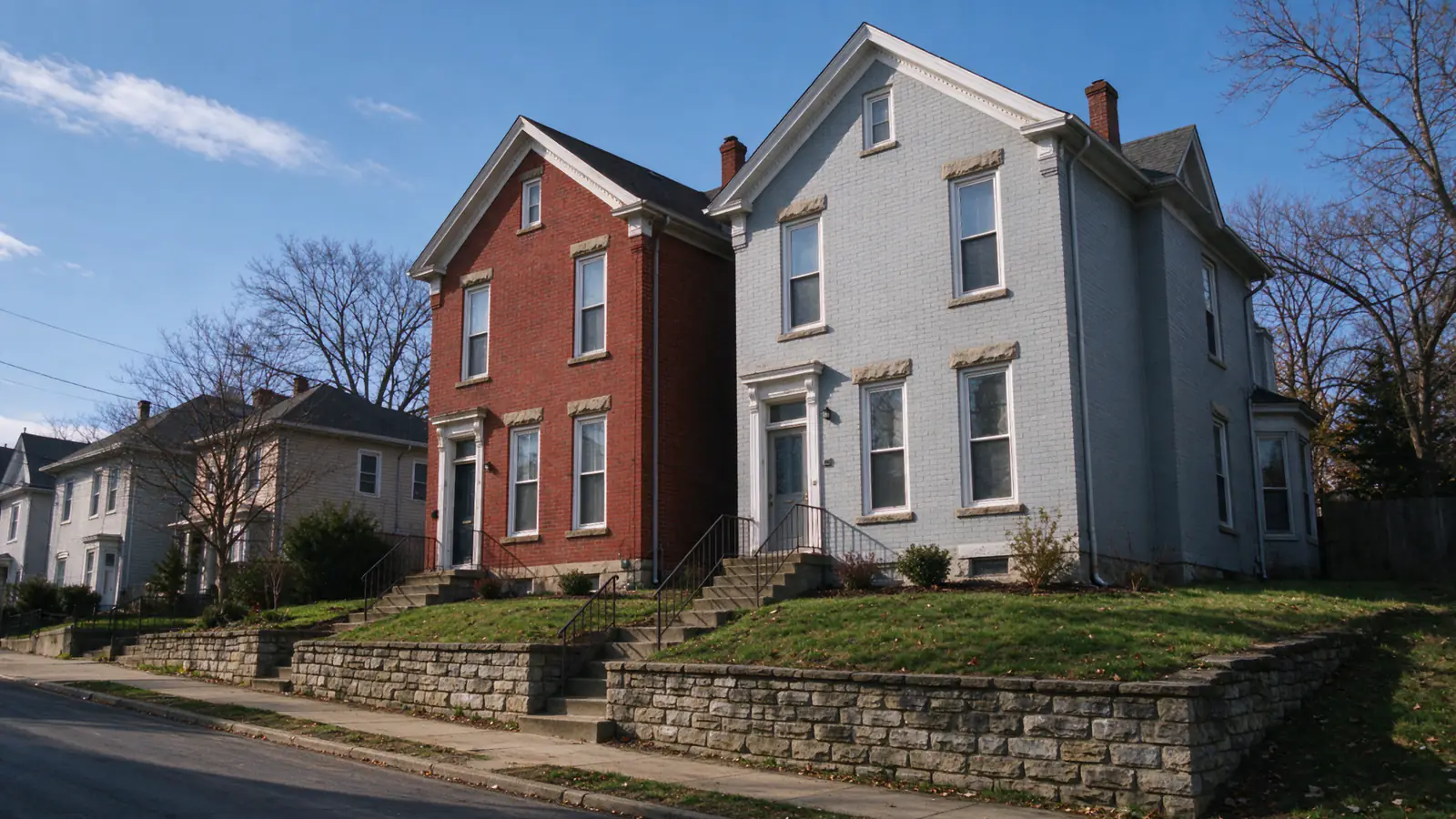
Old wiring in a Mount Auburn house or two-family?
An insurer’s letter, a unit between residents, or a stair light that dies with the other unit’s fuse. At Conflux Cincinnati Knob and Tube we handle knob and tube replacement in Mount Auburn and Prospect Hill, tracing both units before we touch either.
Rewiring indoors rarely needs historic review here, even on the steep streets inside the Auburn Avenue and Prospect Hill districts. The outside is where the district line matters, so we check your address first.
Is your house in a historic district?
Maybe. Mount Auburn holds two local historic districts, Auburn Avenue at 46.7 acres and Prospect Hill at 27.8 acres, and the answer decides who reviews anything that shows on the outside.
| Kind of work | Inside Auburn Avenue or Prospect Hill | Elsewhere in Mount Auburn |
|---|---|---|
| New circuits run inside walls, floors and ceilings | No Certificate of Appropriateness when nothing changes outside | Electrical permit only |
| Meter base moved, service mast added, disconnect on a visible wall | A Certificate of Appropriateness can be needed | Electrical permit only |
| A building permit pulled for the same job | Sent to the Historic Conservation Office automatically | No historic referral |
How do we check the district line?
District lines are drawn on the City’s map, and they don’t follow the neighborhood name. Two houses a few doors apart can sit on different sides of a boundary, and a whole street of Mount Auburn can lie outside both.
Where a service upgrade might move the meter or add a mast, we check your address against the map before we draw any exterior location. Keeping the meter where it already is often avoids the question. The guide to rewiring in a historic district covers the review in more detail.
Do both units share a basement?
Often, and that is where circuits cross. Two-unit buildings account for 13.3% of Mount Auburn’s housing units, against 8.5% for the city. Where both units’ meters sit in one basement, a circuit feeding the stairs or the laundry can belong to neither unit on paper.
That is why we trace a Mount Auburn two-family as one building before we touch either unit:
- Both panels, every circuit. We follow each fuse or breaker to its rooms and check fuse sizes against the wire they protect.
- The house circuit. We find the hallway, stair, basement and porch lights, whichever panel they hang from.
- Who keeps power. Each occupied unit keeps one working circuit for a freezer, an office or a medical device, and in winter the heating circuits stay on.
- Crossovers moved. We move a load fed from the wrong unit to where it belongs, so each panel directory describes only its own unit.
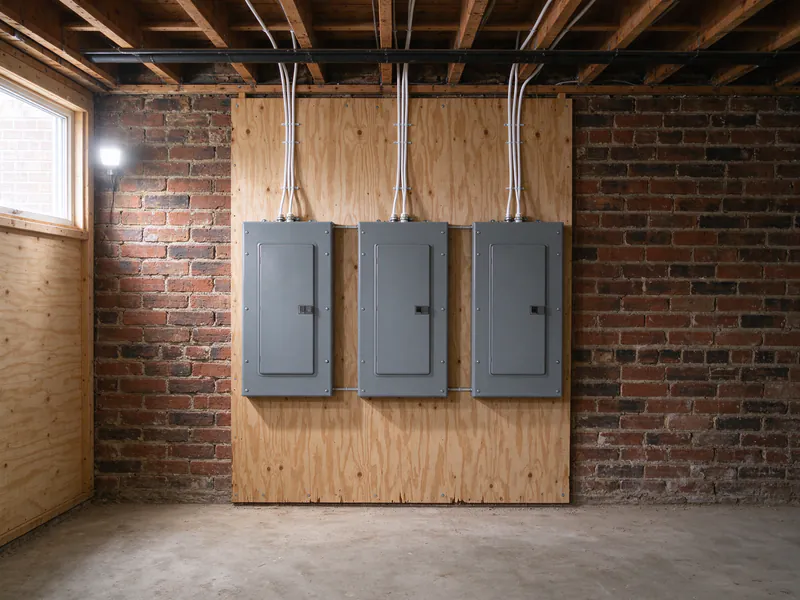
Another 11.7% of units sit in three- and four-unit buildings. A building with four or more units falls under the Ohio Building Code rather than the residential code, which changes the permit path. Two-family and rental rewiring explains how we sequence occupied buildings.
Is your house old enough to have knob and tube?
Probably. Census estimates put 1,598 of Mount Auburn’s 3,145 housing units, or 50.8%, in buildings from 1939 or earlier. That tells us where knob and tube is plausible, not whether it is still live.
| Housing units | Mount Auburn | Cincinnati |
|---|---|---|
| Built 1939 or earlier | 50.8% | 40.3% |
| Built before 1950 | 56.0% | 48.6% |
| Detached houses | 25.2% | 38.4% |
| Two-unit buildings | 13.3% | 8.5% |
| Three- and four-unit buildings | 11.7% | 12.1% |
Source: the Census Bureau’s American Community Survey, 2019-2023, with three tracts combined to approximate Mount Auburn.
Who is allowed to wire a house here?
Two checks apply to anyone wiring a house here: an Ohio electrical contractor license from the OCILB, and a registration with the City of Cincinnati before the work starts.
Registration costs $130, which is a $125 fee plus a 3% technology surcharge and a 1% financial recovery fee. It also requires liability cover of at least $100,000 per occurrence and $300,000 aggregate, and proof of Ohio workers’ compensation.
How does the permit work?
Inspection Bureau, Inc. handles electrical permits, inspections and plan review for the City, and the application goes to IBI directly. If the job also needs a building permit, that one is separate.
IBI inspects the rough-in while the cable is still visible, then returns for the final. Its own guidance is blunt about the order: it cannot approve an installation it cannot see, so no ceiling or wall is patched before that visit.
- Hiring a K&T electrician in Ohio lists what to ask a contractor for before work starts.
- The Cincinnati electrical permit guide walks through the application and the inspections.
How much plaster will we open?
As little as the walls allow. Most Mount Auburn rewires happen in plastered rooms, and where an interior wall is framed with lath behind the plaster, we can usually fish cable through a stud bay with small openings at the top and bottom.
Where plaster sits directly on brick, there is no cavity, and we route through a partition, a closet or the floor above. We count likely openings room by room on the first visit, so the estimate and the patching scope start from the same list. Plaster-wall rewiring describes the routing choices.
What will it cost?
Conflux’s typical range is $12,000 to $35,000 and up for a whole house and $2,000 to $10,000 for a partial job. IBI’s permit fee is small and depends on how many families the building houses, starting with a $60 processing fee.
- A single-family house: $60 for added wiring, so $120 with processing.
- A two-family house: $65 for added wiring, so $125.
- A three-family house: $70 for added wiring, so $130.
- Extras: $25 per house meter, $40 for each reinspection trip, and a double fee for work found under way without a permit.
The rest of your price depends on the building, starting with how many circuits test live. The cost guide explains each part, and partial replacement covers doing one unit now and the other later.